

Play behind bars
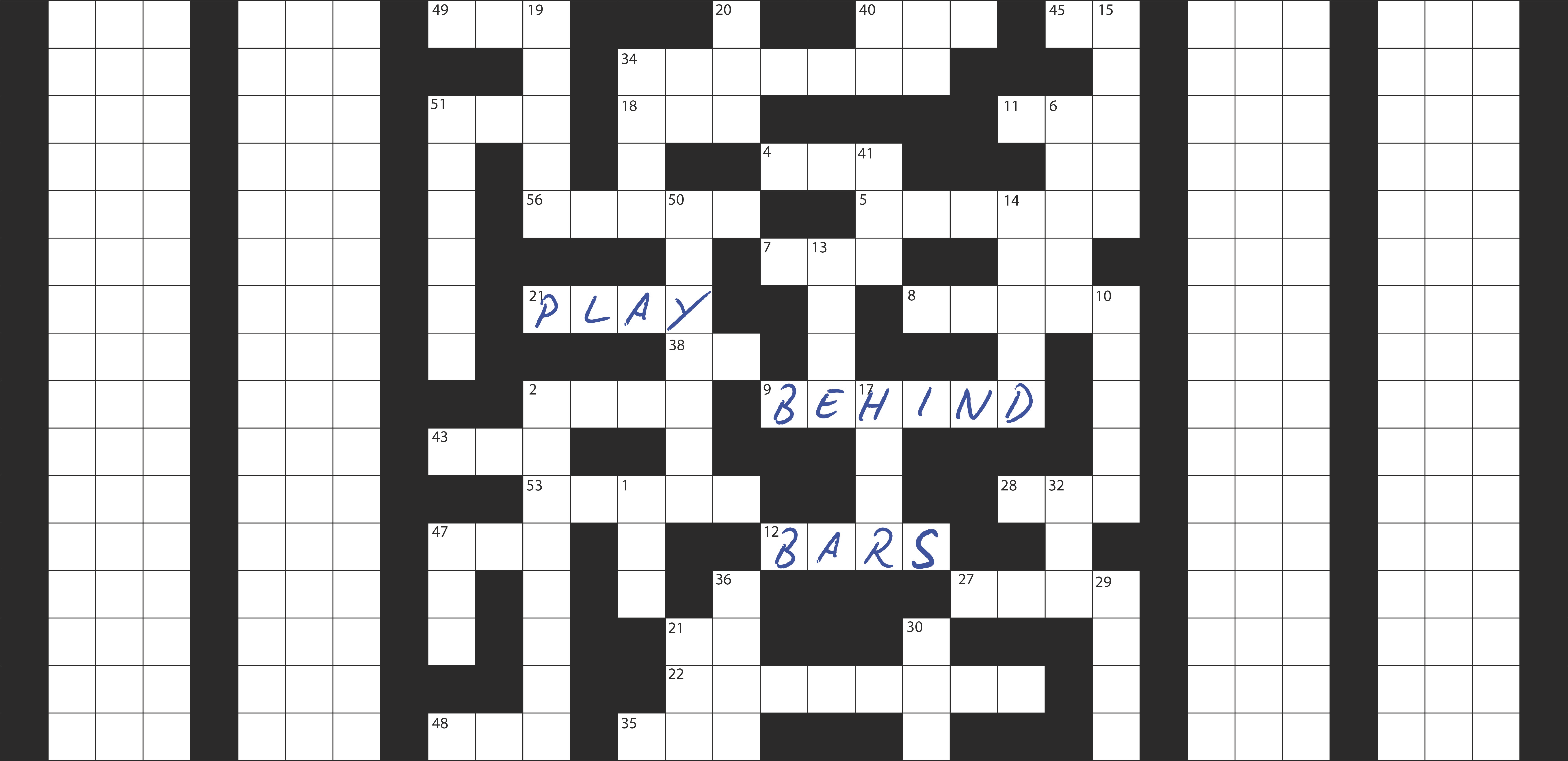
Crosswords – by Keri Blakinger

In jail, there were no dog pieces. There were top hats and tiny thimbles, silvery wheelbarrows and shabby boots. But every single Monopoly set in the Tompkins County Jail was missing the best thing: the dog piece.
The reasons for this were the subject of surprisingly juicy rumors – tales that never quite seemed credible, but were passed along from inmate to inmate nonetheless. From where we sat, we had no way to fact-check the veracity of the stories. Sometimes, we tried asking the guards – but they smirked and refused to answer, which only added to the mystique. Generally, the story went something like this: Once upon a time, an enterprising inmate had realized that the front paws of the Monopoly pooch were the exact dimensions needed to fit perfectly into the oddly-shaped security screws that held in the windows. Under the cover of darkness, one night he’d painstakingly unscrewed them all, somehow lifting off both the inner and outer panes without triggering any alarms. Then he’d climbed onto the upper bunk and slithered out the long, horizontal window near the top of the cell. We knew he didn’t get far – maybe he just stood in front of the window and tasted free air before a guard came running out to tackle him, or maybe he’d at least started running toward the parking lot. Regardless, within the hour he was back in a cell and facing the possibility of an added escape charge. I’d like to think he brought along a “Get Out of Jail Free” card from the game and handed it to the guards after they recaptured him, but that was never part of the story.
With no internet access or local library card, that jailhouse lore was as good as true to us – and it came up every time someone new picked up the cellblock Monopoly set and proposed a game. But despite all the hours we spent talking about it, Monopoly was not actually the most popular game behind bars – maybe that missing dog piece reminded us too much of where we really were, or maybe we just didn’t have the attention span for long games after so many years of drug use. Whatever the case, in general we chose card games over board games.
That was, at least in part, a matter of practicality: You can still play a game of cards between the metal bars of a cell. And since it seemed that there was always at least one person left locked in their cell all day for some perceived misbehavior, games that could be played easily between metal bars were preferable.
To that end, there were a few decks of Uno cards in each cell block, with tantalizingly bold colors we rarely saw behind bars. There was usually a deck of Skip-Bo cards floating around featuring similar shades of red and blue and green and a similarly simple set of rules. Compared to the drab cinder block walls and ratty jailhouse uniforms, the game cards looked so bold and fun. But realistically the target audience is kids, not convicts. As an adult, the games themselves were only actually fun for about five minutes. Beyond that, it was just killing time – which we did a lot of in jail.
If I had to guess, I’d say Spades was the number one game behind bars. Not only was that true where I did time, but it’s probably true anywhere that playing cards aren’t banned. Typically a four-player game, the only required supplies are a regular deck of cards and a pencil and paper for keeping score. It’s a trick-taking game in the same family as Bridge, and is conducive to long, long, long hours of play. Despite its popularity, in my mind the game belonged in the same category as Ramen noodles, packaged honey buns and orange clothing – all things that so intrinsically symbolized incarceration I wanted nothing to do with them.
I understood the attraction, though, and it was something deeper than a mere escape. In a chaotic world where the most important rules could change at the whim of a guard who might toss you in solitary because he had a bad day, games offered a rare and comforting consistency. The rules were defined, and they made sense.
During the 10 months I spent in the county jail, my source of both constancy and escape was the New York Times crossword puzzle. Every day, the facility had three copies of the newspaper delivered, all paid for by profits from the absurdly overpriced commissary.
But with 100 inmates to share the paper between eight cell blocks and four dorms, there was no telling when my daily reprieve would arrive. Sometimes, a pristine copy would plop onto the metal table next to the breakfast trays. Sometimes, a dog-eared mess with missing sections would slide under the cellblock’s steel door after dinner.
It all depended on the mood of whatever guard was working and on the willingness of other blocks to part with their copies. Usually, the papers passed from block to block with ease, as almost all of the inmates gave them no more than a cursory glance. In jail, it seemed, most people didn’t really want to read the news. In some sense, the news was just a reminder that there was still an outside world, a place where everyone else was moving on and leaving us behind.
But crosswords don’t leave you behind. An “oe” is a whirlwind in the Faroe Islands whether or not you are free. A “lek” is still the currency of Albania, whether or not you’ve been arrested. An operatic solo is always an “aria,” even if you’re locked alone in a cell.
Before my arrest, I had a long history of crosswording. In ninth or tenth grade, my figure skating coach actually staged an intervention because I was coming to practice sleep-deprived due to too much middle-of-the-night puzzle-solving. I think crosswords appealed to my obsessive nature – a nature that did not serve me well when I discovered the love for the addictive chemicals that landed me in jail – and also felt like a realm that I understood and could control. As a powerless teenager, they were building blocks for my own little kingdom of words.
But once I landed in jail, they were more than that. After so many years of bad choices and missteps, those puzzles sometimes seemed like the only thing I knew I could get right when I’d massively screwed up everything else. I wasn’t sure how to manage life without heroin, but I knew how to work out the long, punny answer in a Wednesday puzzle or catch the sly trick scattered throughout a Thursday grid. Between the black and white squares lay the one place where I had all the answers.
After ten months in the county jail, I was eventually sentenced to 2.5 years in prison, and transferred upstate to finish out the remainder of my sentence. I kept doing crosswords, though (allegedly) for security reasons we weren’t allowed to get newspaper subscriptions delivered until a day later. And since there were no commissary-funded communal papers there, the local rag wasn’t as easy to find. Instead of enjoying the daily progression through the week’s puzzles, I reverted to thick collections of New York Times crosswords.
Once I got out, I kept at it, albeit at a slower pace. Regular life took over as I started building a career – as a newspaper reporter. First I worked in Tompkins County, where I’d lived before my arrest. But then I moved on to New York City, then Houston, then Austin, then Los Angeles. Almost ten years after I got out, I started writing a book about my addiction, my arrest, and my journey through the legal system. When I got to the chapters on my months in the county jail, I decided – on a whim – to fact-check the jailhouse lore I’d heard so long ago.
“I realize this is a very weird, niche question,” I wrote in an email to a jail lieutenant, and proceeded to explain. At first, I thought he had ignored me. But a week after I sent it, he responded: “Lol! The feet on the dogs (or maybe the ears) tend to fit nicely in a security-type screw head. Not gonna escape with it but inmates could remove outlet covers in the housing unit. Mostly cause security issues for us.”

🏨
That is very different .