

Play Unplanned
Tim Walsh on the unlikely origins of some of the most playful of playthings.


Some people define play as “the spontaneous activity of childhood.” Children effortlessly weave entire worlds on a whim. Adults play too. We are neotenous, meaning we have the ability and need to play throughout our entire lives. Donald Winnicott, the English pediatrician and psychoanalyst, said, “Creativity consists in maintaining a key aspect of the experience of childhood throughout one’s life: the capacity to create and recreate the world. Creativity is the omnipotence of the child’s mind.”
Play can happen spontaneously, and so can playthings. Some of the greatest toys were realized through the creative exploration of things far removed from anything fun. Dull, dire, or even deadly conditions have resulted in worlds reimagined.
On 7 December 1941, Japan attacked Pearl Harbor. But it was what happened the day after the “day that will live in infamy” that led, in time, to a timeless toy. On 8 December 1941, Japan captured Singapore for the Axis powers, the place where 90% of the world’s natural rubber was produced. As a result, the strategic war material needed to make gas masks, boots, tires, and surgical equipment was severed from the US and its Allies. If what Winnicott said was true, then our ability to create and recreate was never more needed than on that day in 1941. The fate of the world depended on it.
No single lab cracked the problem. In the end, it was a consortium of rubber research specialists who cooperated to create a general-purpose, synthetic rubber that was given the most 1940s government lab name ever: GR-S, or “Government Rubber-Styrene.” Mass production ensued, another significant achievement, and the war was eventually won. Our collective ingenuity had saved the day.
Of the many chemists who contributed to this serious work, one in particular stumbled on something silly. Chemical engineer James Wright mixed silicone oil and boric acid together at General Electric’s New Haven, Connecticut Laboratory and was surprised when they polymerized. To test the polymer’s pliability, Wright rolled it into a ball and threw it on the floor. He named it Bouncy Putty.
Further testing revealed that long molecules in the putty could slide over one another and allow it to flow like a liquid. Those same molecules were linked, and in response to rapid force they caused the rubber to behave like an elastic solid. Under extreme force, it acted like a brittle solid and shattered. The liquid/solid identity crisis it suffered made it a poor synthetic rubber. Still, GE promoted its use as a hand exerciser, wobbly furniture leveler, a sealing compound, and even predicted its use as a “novelty item.”
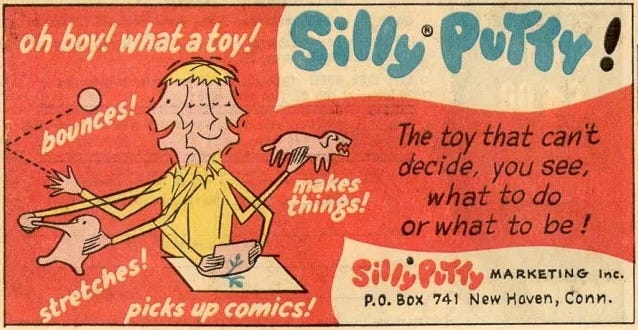
Enter copywriter and marketer, Peter Hodgson. He was introduced to the odd ooze through a friend, and after hearing how it was becoming a cocktail party fad among GE executives, thought he might be able to sell the stuff as a toy. He discovered that at least two other entrepreneurs were already selling it as Bouncing Putty; so to set his apart, Hodgson named it Silly Putty and packaged it in plastic eggs. It debuted at the International Toy Fair in 1950, where Hodgson landed an order from Doubleday. When a writer from The New Yorker discovered egg cartons of Silly Putty at the Doubleday bookstore in New York City, he decided to feature it in the column, “Talk of the Town.” Hodgson was immediately deluged with orders and Silly Putty became a sensation.
Although it was never a suitable synthetic rubber, Peter Hodgson’s marketing magic allowed James Wright’s Bouncy Putty to contribute more than its fair share of fun to a world recovering from the war. In 2025, Silly Putty celebrated its 75th anniversary. Light years removed from its laboratory launch in 1943, it established a new toy category called compounds. Today there’s no end to the slime, sludge, floam, flooze, and fun started by Silly Putty.
Around the same time that chemical engineer James Wright made Bouncing Putty, mechanical engineer Richard James was trying to stop naval instruments from bouncing on rough seas, and thought that suspending them from springs might do the trick. When he accidentally knocked a spring off his table, it did a trick he wasn’t expecting… it walked. Ever the engineer, he propped up some books and re-ran the experiment. After a few trials, he could duplicate the results.
Richard brought the spring home to his wife Betty, who doubted his claim that he could turn it into a toy, until he showed it to some neighborhood kids who loved it. Once on board, Betty was given the task of naming it. She combed through the dictionary before landing on a word that meant “stealthy, sleek and sinuous.” The name was Slinky. The couple formed “James Industries” and hired a local machine shop to make 400 copies. Once Betty had hand-wrapped them in a yellow paper instruction sheet, Slinky was ready to meet the world.
Slinky elicits multiple memories. You can picture it walking down stairs, feel the coils cascading in your hand, and hear its “Slinkety sound.” But in 1945, no one knew what it was or what it did. Slinky’s springboard moment came when Richard convinced a buyer at Gimbel’s department store in Philadelphia to allow him to demonstrate the toy there. Once people saw the Slinky spring do its thing (namely, walk down a sloped plank that Richard had brought with him to the store), all 400 sold in twenty minutes.
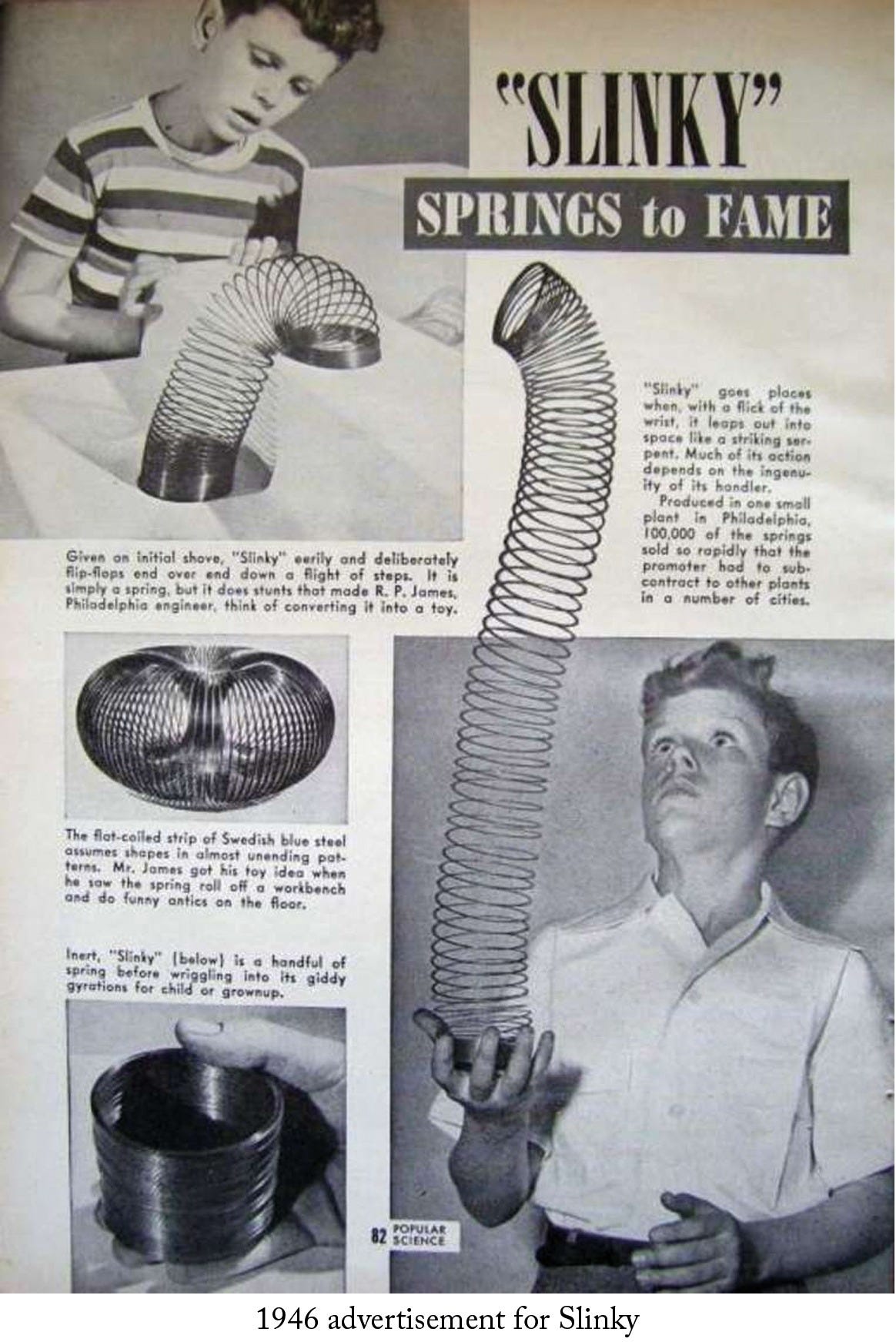
For a toy that only moved downhill, the ascent of Slinky was insane. In less than ten years from its launch, James Industries sold over 100 million of them, all made on machines designed and built by Richard James in 1945. The Slinky Dog was released in 1952, and then rediscovered by a new generation of fans through the Toy Story films. Slinky was inducted into the National Toy Hall of Fame in 2000, a fitting tribute to a piece of Americana that had started out as a tool and ended up as a toy for the ages.
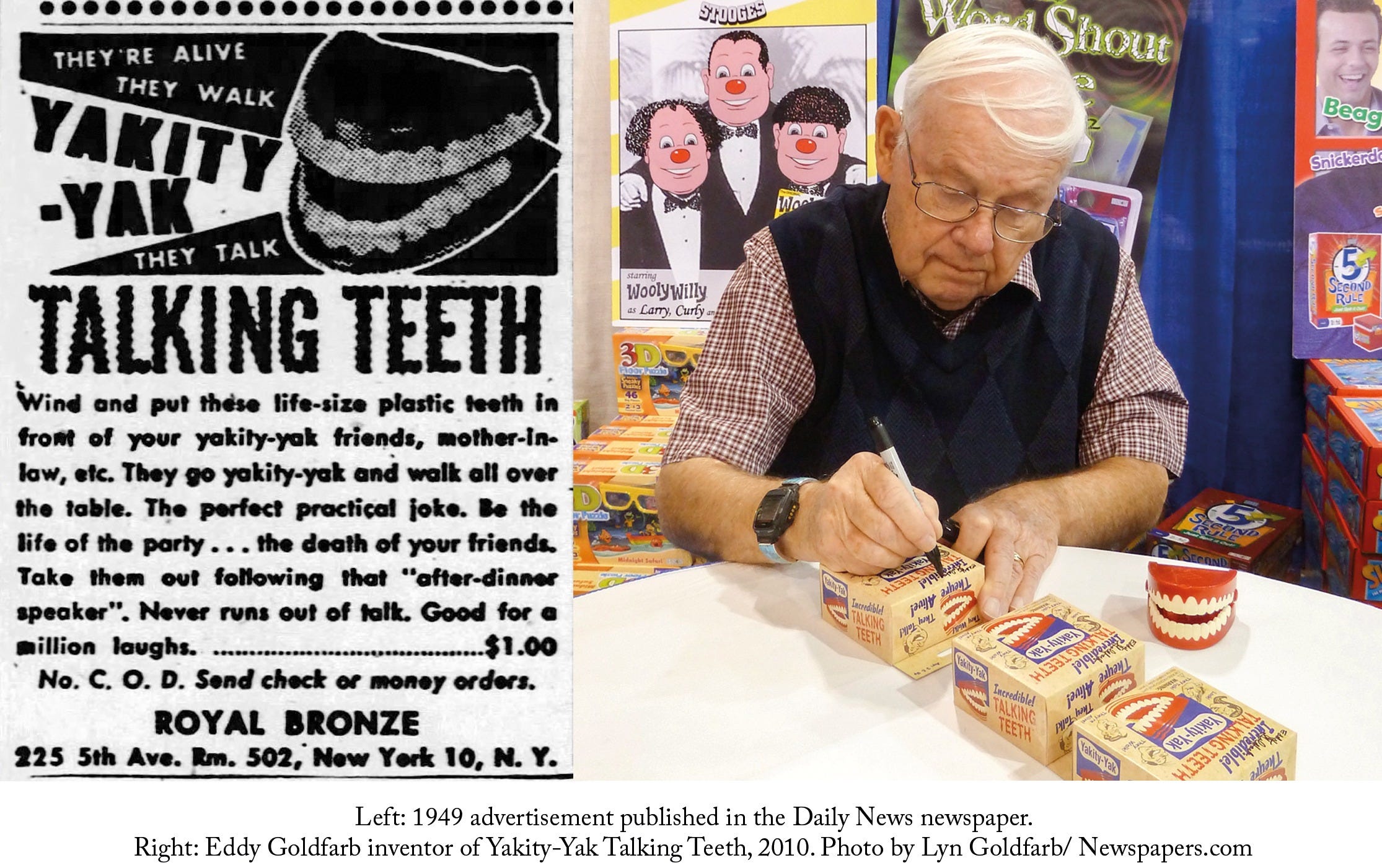
At the ripe old age of 104, Eddy Goldfarb still plays. He has designed hundreds of toys and games over his 79-year career, including Kerplunk, Battling Tops, Stompers, Shark Attack, and more. But in Chicago in 1947, when he was just starting out and only 25 years old, the idea of aging was far funnier. His career was catapulted when he opened a newspaper and saw an ad selling a jar for dentures. It was called the “Tooth Garage,” and was for “Anyone who has a sense of humor and a removable bridge or set of false teeth.” Eddy laughed, and then a lightbulb went off. What if a set of false teeth could move on their own? He went to his dentist and asked for a set he could use as a template for his prototype. The hand-carved result was one of the most famous novelty toys in history: wind-up, false chattering teeth.
He showed his model to Marvin Glass, another legendary toy designer with whom he was working at the time. “Marvin was a dynamic salesman,” Eddy said. “I just wanted to invent.” Marvin sold the idea outright to H. Fishlove & Co. for $2,500. Eddy’s cut was $900. Released in 1949 as Yakity-Yak Talking Teeth, the toy went on to be so successful that Eddy vowed he’d never sell a toy again without a royalty. Ever the optimist, he added, “It wasn’t a bad deal. I bought a winter coat. In Chicago, I really needed that.”
Surviving winter has never been a laughing matter. For eons, we burned wood to keep warm; until the 1880s, when coal replaced wood as the world’s most widely used heating fuel because it burned hotter, at about half the price. The only downside was the sooty mess that spread across a home heated by coal. Naughty little kids knew another dreaded fact about the fossil fuel: Santa left lumps of coal in stockings instead of toys. Yet, without coal (and the mess it made), we might never have experienced one of the greatest toys ever.
Coal soot presented a particular problem for non-washable surfaces like wallpaper. Homeowners of that time would mix flour, water, salt, and borax to create a paste they would press against their wallpapered walls to pull off the coal soot. This arduous spring-cleaning custom became so common that soap companies like Kutol Products, in Ohio, began selling pre-mixed wallpaper cleaner. Kutol Wall Cleaner was a best-seller over 20 years until the early 1950s, when oil and gas began replacing coal-fired furnaces. At the same time, vinyl wallpaper, which could be washed with soap and water, was introduced. Seemingly overnight, Kutol’s core product line became obsolete.
Schoolteacher Kay Zufall, the sister-in-law of Kutol co-owner Joe McVicker, was working at a nursery school when she read an article about using wallpaper cleaner to mold Christmas tree ornaments. The fluffy stuff was non-toxic and could be molded into all kinds of creative shapes. After successfully trying it with her kids, Kay called Joe and suggested a solution to his company’s slow sales: turn the cleaning compound into a modeling compound. Joe loved the idea, and with just a tweak to its ingredients (detergents removed and colorants added), Rainbow Modeling Compound was born. Almost.
Kay was Kutol’s go-to kid expert. After all, she’d had the idea and worked with children for a living. When Joe told Kay the name, she gasped. Rainbow Modeling Compound didn’t sound fun at all! Joe was panicked, as a decision to start production had already been made. Kay pleaded for time to come up with a better name and Joe agreed. After consulting with her husband, Bob, Kay called Joe the next day and simply said, “Call it Play-Doh.”
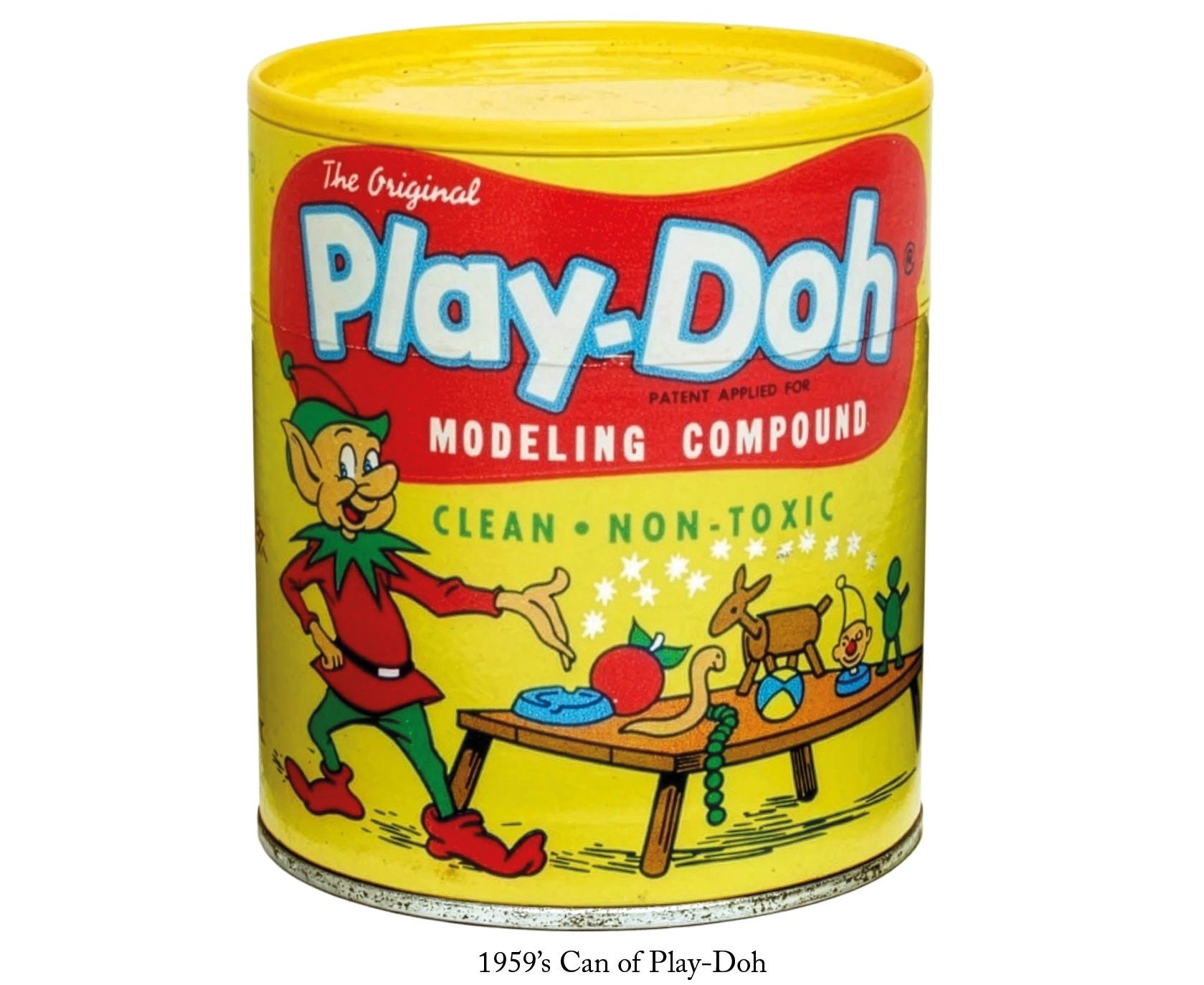
Joe formed Rainbow Crafts as a subsidiary company of Kutol and rolled the first cans of Play-Doh off the assembly line in 1955. Play-Doh didn’t stain like clay and was easier for kids to mold. Soon every elementary school in Cincinnati was a customer. From there, Rainbow Crafts got Play-Doh into stores like Marshall Field’s in Chicago and then on national TV, courtesy of Captain Kangaroo. Food giant General Mills, seeing money in all that dough, bought Rainbow Crafts in 1965 for $3 million. It proved a steal. By 1972, over 500 million cans of Play-Doh had been sold. Today, Hasbro sells over 95 million cans of Play-Doh every year.
Toyland is now regarded as a smoke-free zone, but that wasn’t always the case. Play-Doh’s packaging once encouraged kids to make ashtrays for Mom and Dad; Mr. Potato Head smoked a pipe; and the surgeon on the cover of the original Operation game dropped cigarette ash onto his patients. In 1955, while kids pretended to puff on candy cigarettes, a businessman who was anti-smoking before it was cool unwittingly created a crossover hit.
Austrian Edward Haas was a candy-maker who in 1927 developed an inexpensive way to make compressed mints from peppermint oil and sugar. After a false start in round form, he switched to a brick shape so that they could be wrapped more efficiently by machine. He took the first, middle, and last letter from the German word for peppermint—PfeffErminZ—to name them PEZ.
The Candy Hall of Fame called Haas “a long-time anti-smoking advocate” who marketed his mints as an alternative to lighting up. In 1949, the first PEZ dispenser was created to look and function like a cigarette lighter and appeal to smokers trying to quit. It could be operated with one hand, and with a flick of the thumb deliver a mint instead of a light.
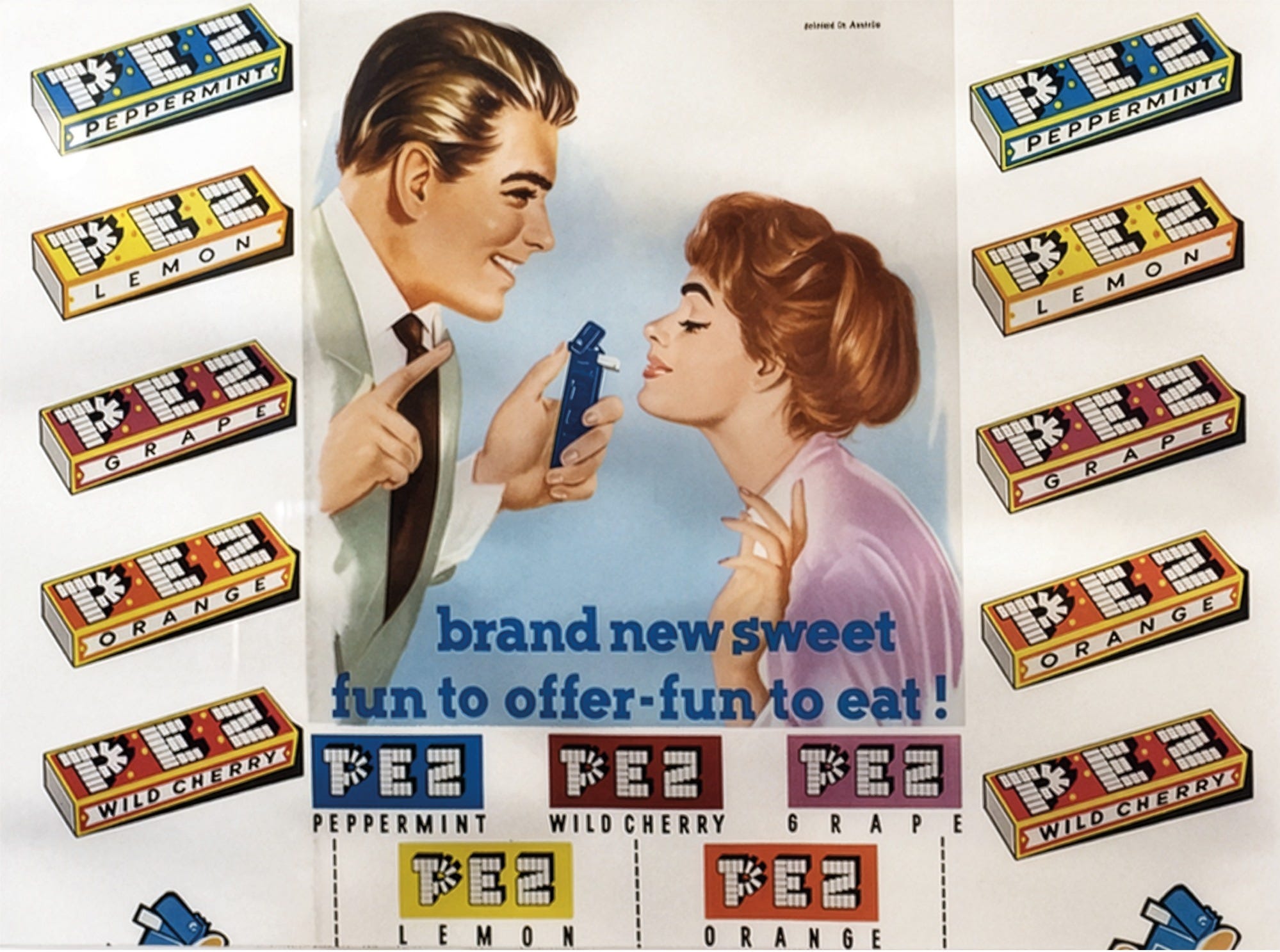
PEZ came to the US in 1952, but after three years of sluggish sales, fruit flavors were added and PEZ was repositioned as a candy. This meant that the cigarette-lighter look had to go, so the dispensers became topped with cartoon heads.
The evolution of the dispenser changed the PEZ identity. As an anti-smoking mint, the dispenser’s original design made sense. But if you’re unaware of its origin, PEZ dispensers feel demented. Why should it be that if you push Mickey Mouse’s head waaaaay back, a candy brick is forced out of Mickey’s throat area? This tracheotomy treat might just feel twisted. But once you know the origins, you will enjoy all the cartoon candy silliness. Again, the evolution of PEZ was very unplanned; it didn’t start out as a toy to give you candy, but it will certainly be remembered that way. Today PEZ dispensers are sold in over 60 countries around the world.
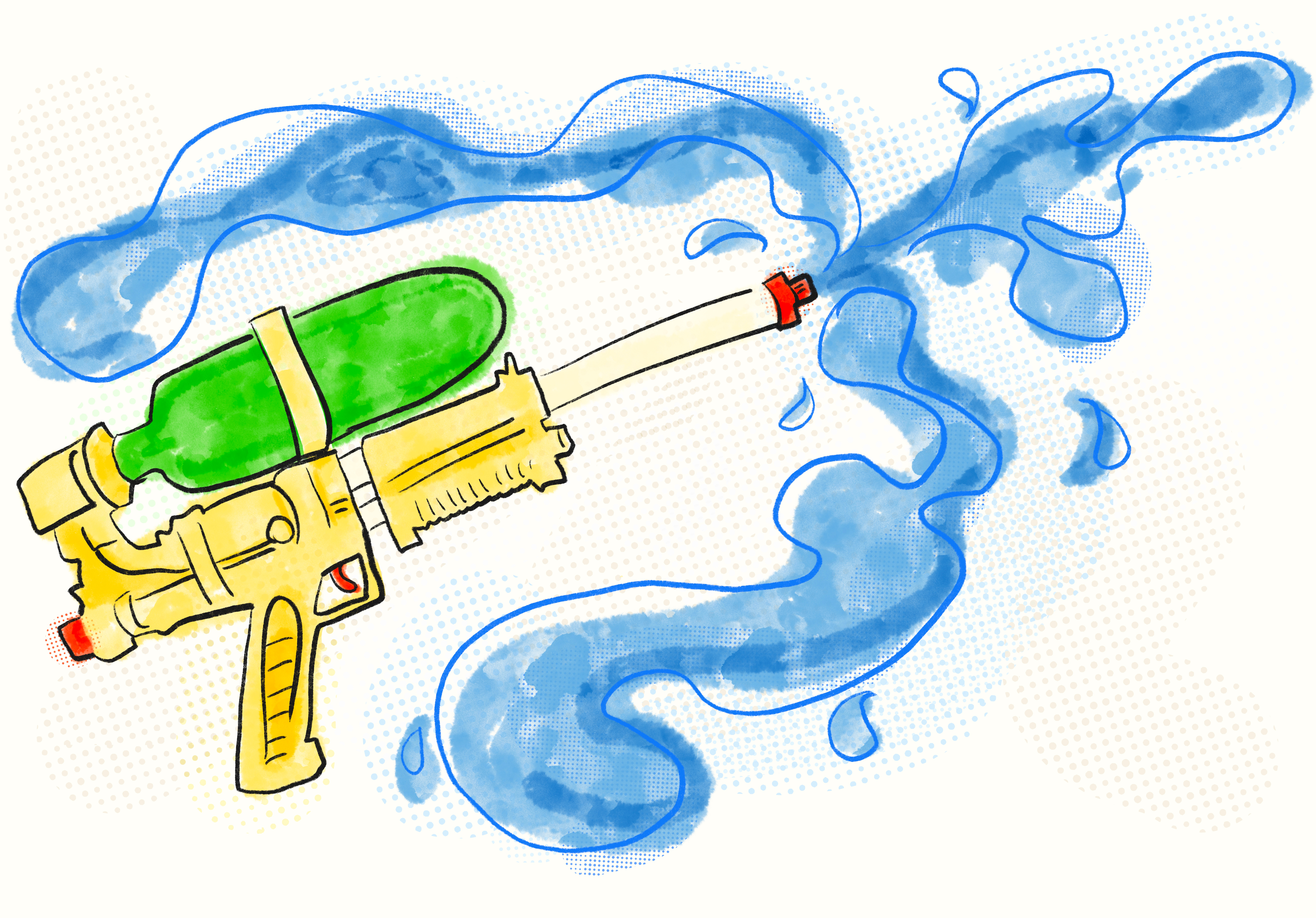
In 1982, aerospace engineer and former Jet Propulsion Lab scientist Lonnie Johnson was working on a heat pump that cooled itself using compressed water instead of Freon. To test it, he attached it to his bathroom sink and turned on the jets. The pressure in his pump shot out a stream of water with such force that Johnson immediately thought, “a high-performance water gun would make a great toy.”
At the time, “water gun” and “high performance” were a contradiction in terms. Squirt gun sales weren’t even tracked by toy industry analysts in 1982. They were cheap, leaky, throw-away items that sold for under a buck. Johnson’s subsequent prototype was a highly-engineered amalgam of PVC pipe, plexiglass, and valves connected to a 2-liter Coke bottle. If turned into a toy, the thing would have to sell for over $10. “No one would ever pay that much for a squirt gun,” he was repeatedly told. But what Johnson had created was no mere squirt gun. His prototype featured a reservoir partially filled with water. By using a pump attached you compressed air into the reservoir, pressurizing the water in the process. Pulling the trigger released a pinch valve on tubing that fed to the gun’s nozzle. The built-up pressure forced out a stream of water over 20-30 feet.
For seven years Johnson failed to find a home for his invention, until he arrived at the offices of a Philadelphia toy company called Larami. Unlike the other companies who were impressed by the toy’s performance but paralyzed by the price at which it would have to sell, the executives at Larami saw an opportunity to create an entirely new category of toy.
After three years of development by Johnson and Larami’s engineering team, Super Soaker hit the world in 1991 with something no water pistol had ever had: a TV campaign. In its first year on the market, 2 million Super Soaker water guns were sold, rewriting the rules of water gun warfare. Over its first three years, over 27 million Super Soaker water guns were sold. Today it’s estimated that “Johnson’s bathroom water pump test” has resulted in over a billion dollars in sales.
That’s the common thread of these tales of heat pumps and putty, dentures and dough: they were not just happy accidents, but the product of the “spontaneous activity of childhood.” Winnicott was right: the capacity to create comes from our childlike ability to weave worlds on a whim; it’s all proof of the power of unplanned play.
🔫
Super interesting read!!! Thank you!