

PLAYHOUSE
Callan Davies tells us how the first playhouse was damned as ‘a show place of all beastly and filthy matters’.

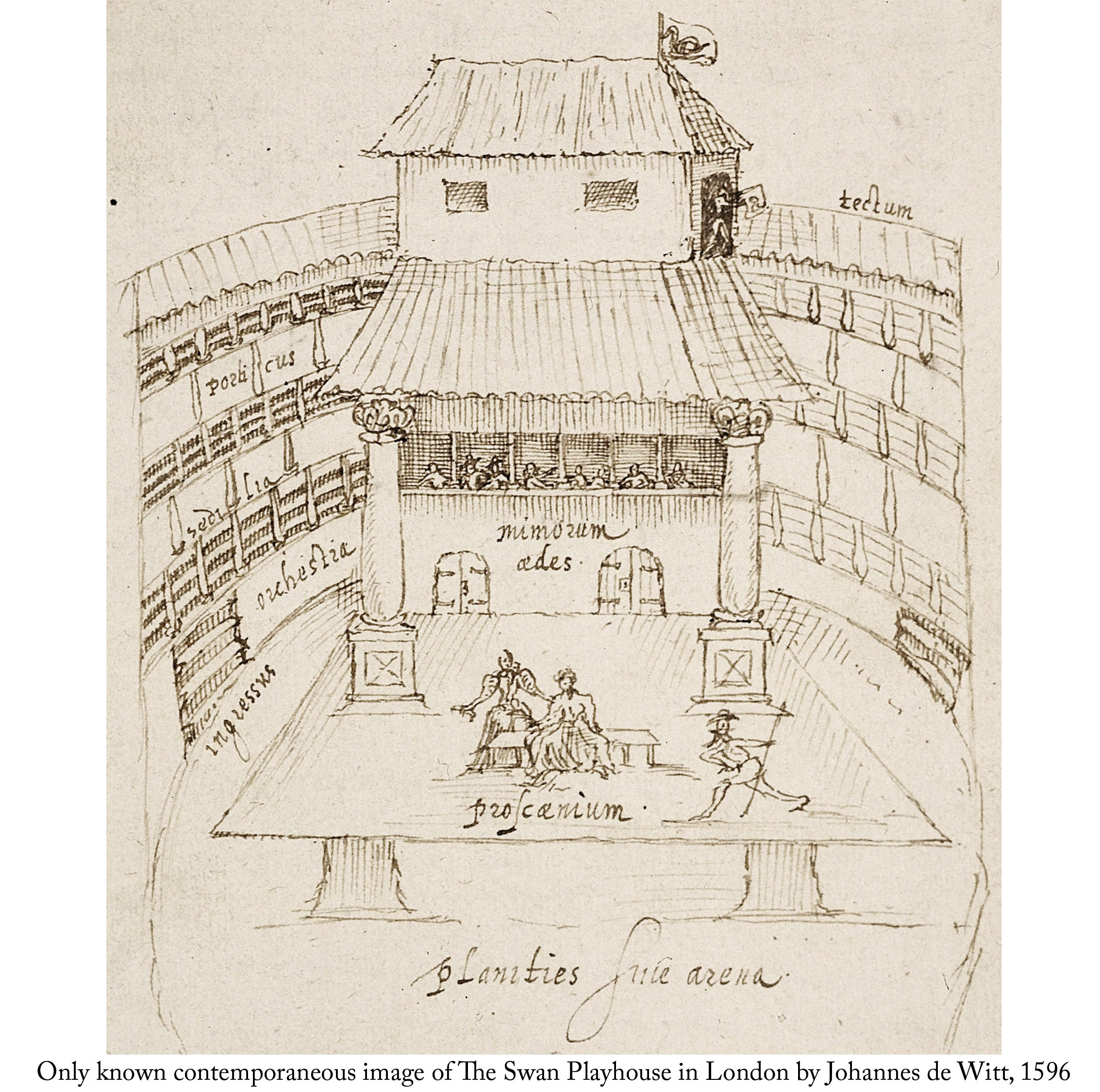
The English term playhouse and the structures we tend to associate with it today have many origins. Let us return, for a moment, to one: the lands of a former priory north of London in 1576, where a woman called Margaret Brayne is hard at work laying bricks. This area is known as Shoreditch. Brayne is busy constructing an outdoor amphitheatre with her husband and his brother-in-law (James Burbage, a close colleague of Shakespeare’s). She later told a court she put in her own hard graft to save money on labour. Brayne and her co-builders fretted about the spiralling costs of this rather expensive structure, but they rightly hoped that it would regularly draw large audiences from London and beyond. When asked by her friends and family about this ambitious enterprise, what did Brayne say she was building?
A passerby some months later struggled with this question himself. The disapproving preacher John Stockwood could not quite find the words to describe the building. “I know not how I might … more discommend the gorgeous Playing place erected in the fields,” he declared, “than to term it, as they please to have it called, a Theatre . . . a show place of all beastly and filthy matters.” Stockwood offers a selection of Elizabethan synonyms for the venue: playing place, show place, Theatre. This last word was its official name—an archaic, rather fancy, Roman term that would have felt peculiar to many visitors. The building is often regarded as a ground zero for theatre historians looking for the “first” proper playhouse, perhaps partly because of its connection with Shakespeare. As the home of the Chamberlain’s Men for most of the 1590s, it would go on to host a range of his early plays.
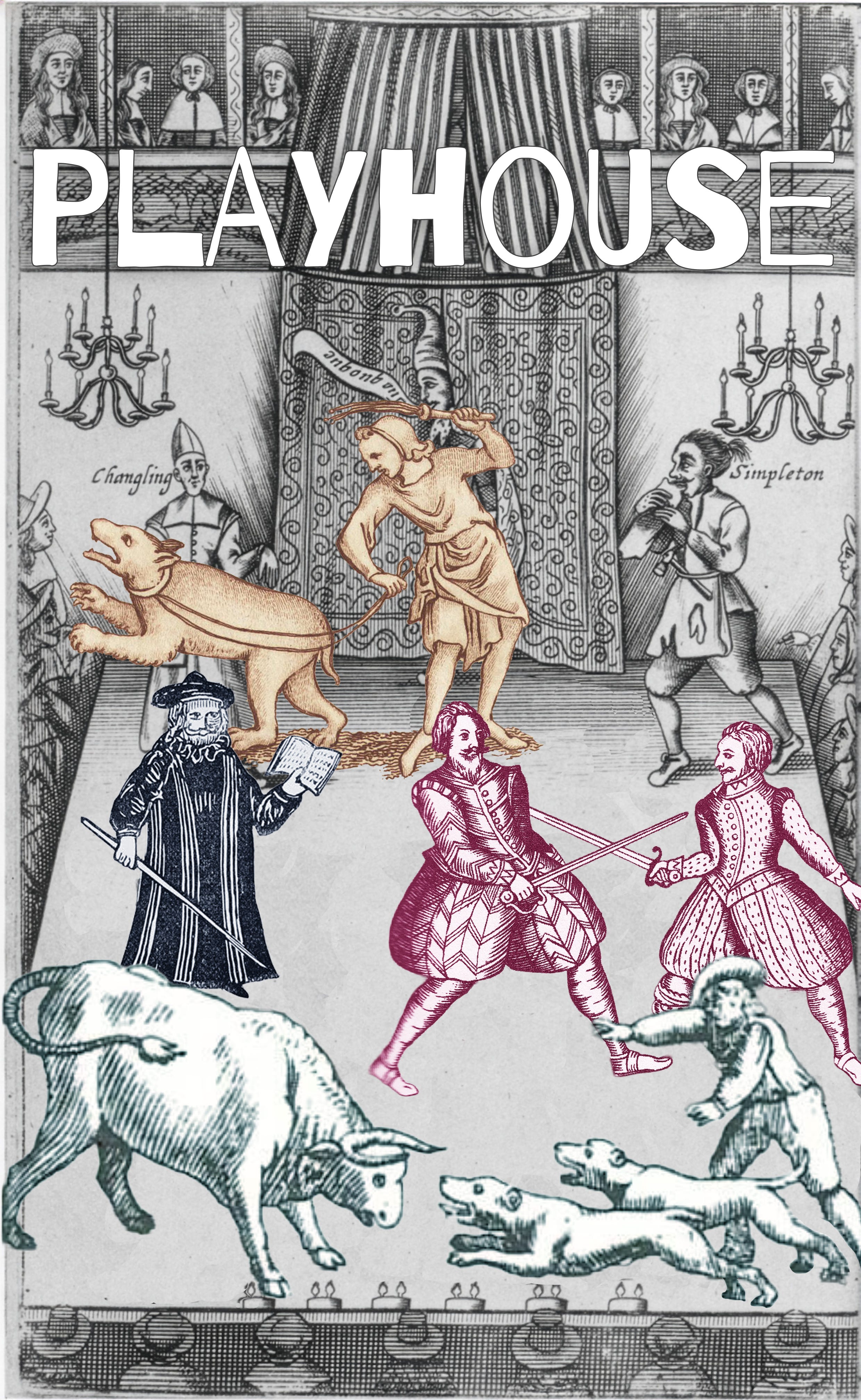
Contemporaries, including Brayne, accordingly referred to the Theatre as a playhouse. The mid-sixteenth-century gifted us much of our current theatrical and entertainment terminology in English. But as Stockwood’s verbal struggles show, words like playhouse did not yet have fixed dictionary meanings. The language of play was in flux, as the industry of commercial entertainment developed apace. The term was (and still is) usefully elastic. In Elizabethan English, play indicated a whole range of activity. Here, and at other even more dynamic venues, visitors came expecting anything from a dramatic performance to games, animal sport, or music, prose reading, or what we might now call stand-up comedy. One of the Theatre’s chief attractions (like many other playhouses) was its fencing prizes—an equivalent to a football match today. They took place regularly and may well have been more of a draw for many audiences than the likes of Romeo and Juliet.
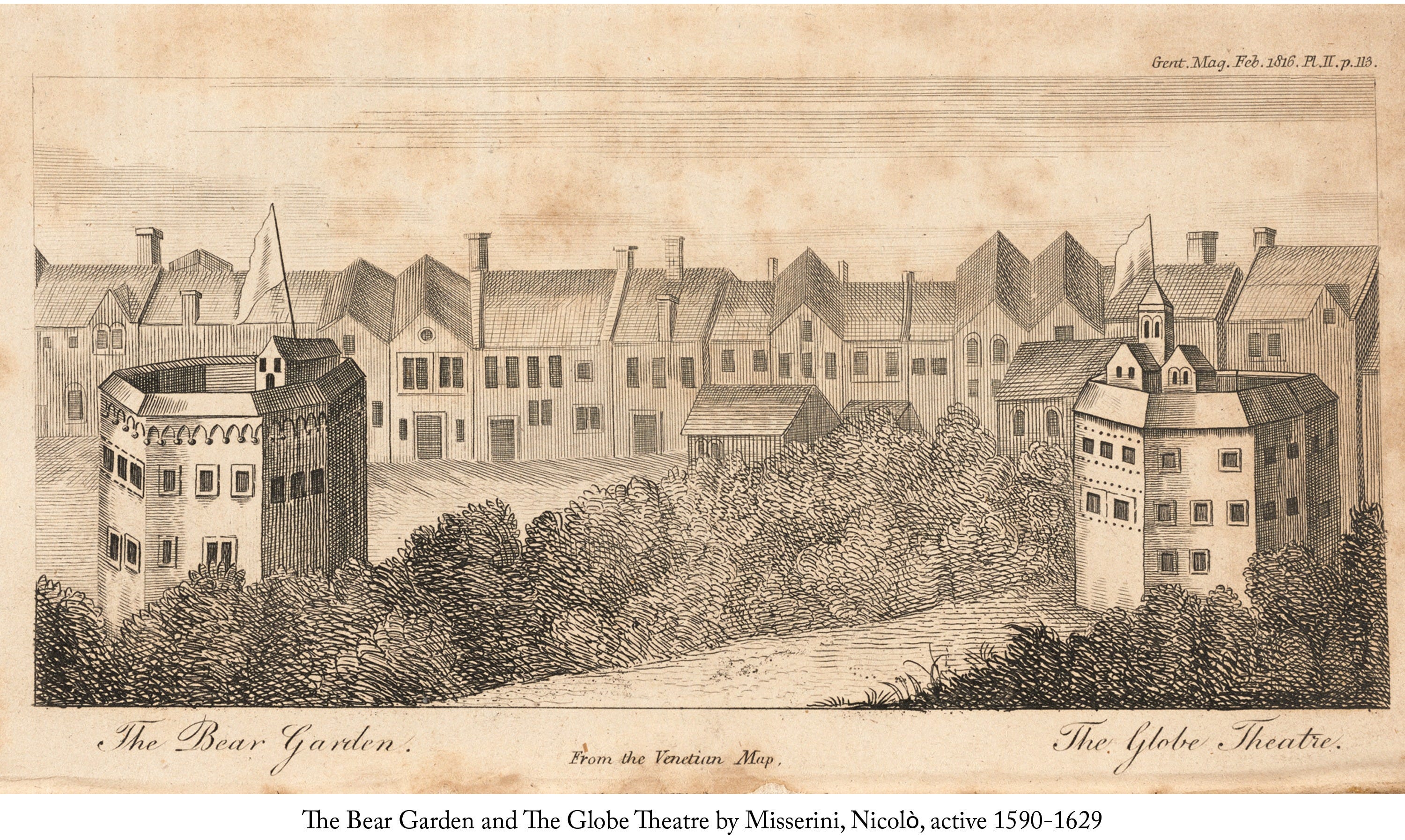
Playhouses, even in their ‘Shakespearean’ sense, were therefore defined by plurality not singularity. When theatrical entrepreneur extraordinaire Philip Henslowe and his partner Jacob Meade built a playhouse called The Hope in 1614, they wanted a space that could host professional dramatic players and animal sport together: a holistic approach to the ‘play’ encompassed in the word playhouse. They knocked down an existing structure generally known as the Bear Garden, which hosted animal blood sports, to build this new venue. John Norden’s early map of London’s Bankside showing the predecessor labels it a ‘bear house’—another Stockwood-like synonym. The Hope, then, tells us something of how audiences long recognised that different play forms might sit within one ‘house’.
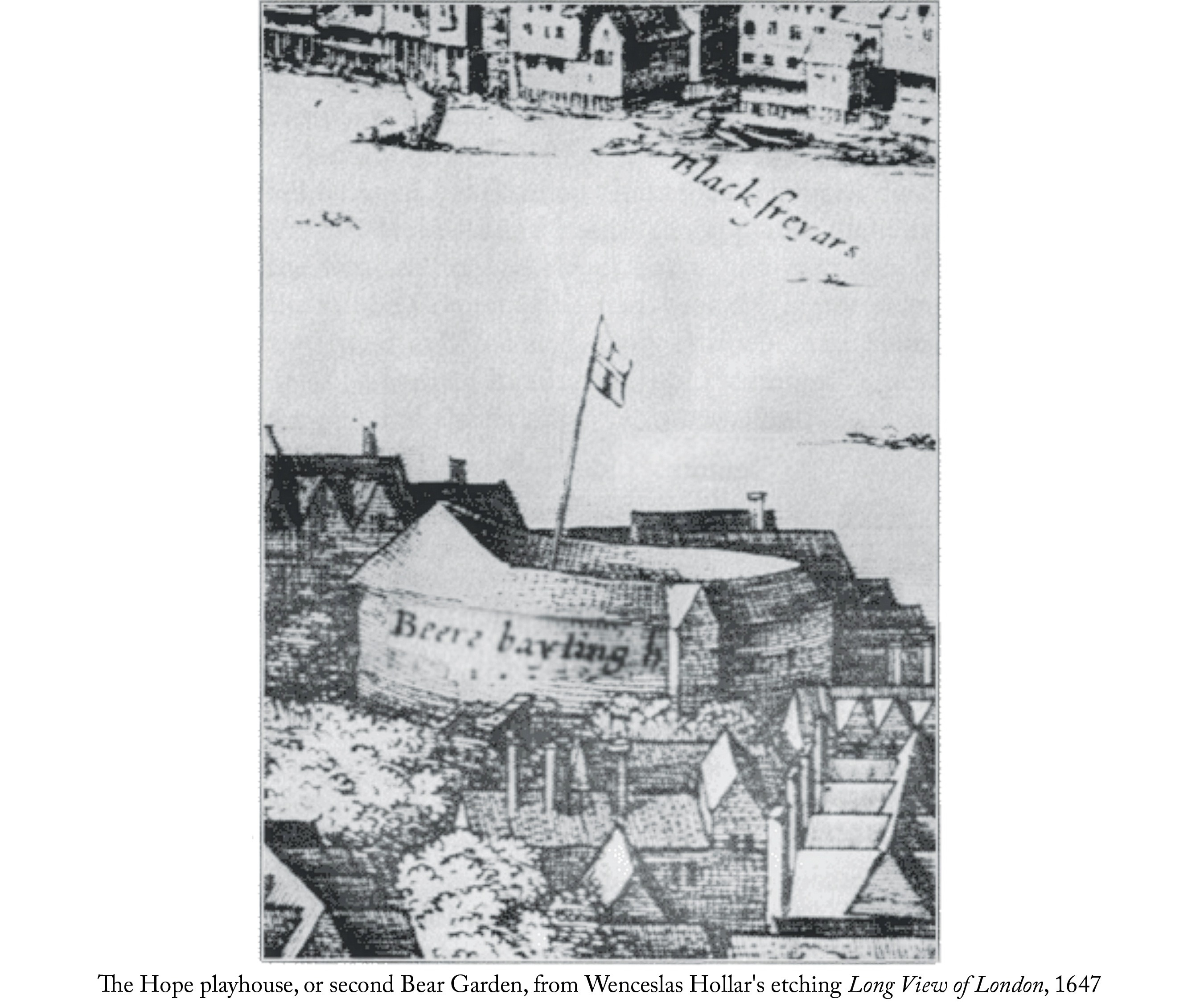
As a noun in Elizabethan English, ‘play’ was applied to bowling contests, fencing moves, or card games. When a German visitor attending what he called a “play” at the earlier “bear house” in the 1580s, his diary entry describes a multimedia spectacular with fireworks, bread, and exploding flowers in which both audience and “performers” were active participants. In 1627, an Ipswich man called Jacob Abadham was fined “for keeping a Playhouse” and bound £10 “not to play at unlawful games.” Abadham’s business takes us a long way from the Theatre—it seems to suggest an alehouse set up for gambling, a kind of proto-casino. But for contemporaries this was an equally viable (if illegal) playhouse.
This Ipswich establishment reminds us that the ‘origins’ of playhouses in England are manifold and diffuse and that they are by no means unique to or driven by London. In 1539, a man called Robert Copping leased a ‘Game House’ from the town corporation of Great Yarmouth, with the requirement that he “permit and suffer all such players & their audience to have the pleasure & ease of the said house & gameplace.” Like ‘bear houses’, playhouses could be game places which could itself indicate performances of various types. Many of their innovative builders or proprietors could be found across England. The Theatre itself, often regarded as an archetypal playhouse, was preceded by a playing structure in Shrewsbury, Shropshire, carved out of a quarry and used “for stage plays and Common plays silver games wrestling Running Leaping, and other like activities and recreations.” These structures needn’t be houses specifically, but could be scored out of the natural environment and built up with seating.
The diversity of ‘play,’ then, applies equally to the ‘house’ part of the term in this entry’s title. When the choirmaster Richard Farrant rented two rooms in the Blackfriars precinct in 1576, he proceeded to “pull down one partition and so make of two rooms one” (as he wrote to the landlord). A theatrical eye for an Elizabethan Location, Location, Location. This simple architectural act created the first known commercial performance space at the Blackfriars, the precinct where the King’s Men would later go on to develop their own indoor venue (host to Shakespeare’s later drama and John Fletcher’s influential tragicomedies). Meanwhile, in early seventeenth-century Bristol, Margaret Woolfe and her husband, Nicholas, owned a tenement building divided into separate rooms to form what we might now call a house-of-multiple-occupancy. One of them regularly hosted so-called ‘comedians’; the street itself welcomed tumblers and rope-dancers. Margaret Woolfe tells us in a lawsuit of 1619 that it was “commonly called the playhouse.”
So many playhouses constructed in the ‘boom’ years of the sixteenth and early seventeenth centuries were not what Elizabethans would call “new built.” Builders like Farrant formed them from existing structures, built between walls and buildings in alley-like spaces, or shored up decaying barns. A number converted tenement buildings or civic structures or even schoolhouses. Records about the Witton Grammar School in Cheshire show a modest 5 shillings “spent by mr winington & my self when we set the playhouse to be repaired” in 1637. Many playhouses continued on their journeys of adaptation, transforming back into domestic residences or divided up into usable materials. When the Theatre was dismantled, many of its timbers found their way into the newly built Globe on Bankside. True to the period’s building practices, this was a performance ecology of decay and renewal, of acclimation to and adaptation of existing environments.
Let us rejoin Margaret Brayne sixteen years later in 1592. We find her hard at work to defend her share of ownership in a structure that had by now been quite firmly—commonly—understood as a playhouse. The venue had entered into a profit-sharing relationship with its very close neighbour, another playhouse called the Curtain, and Brayne felt entitled to half of the profits from both. The Theatre and the Curtain were frequently coupled in contemporary references. One hostile commentator, Philip Stubbes, pairs them together as “Venus’s Palaces.” Yet recent archaeological discoveries have shown how different these two structures were. Whereas the Theatre was a round-ish building, the Curtain was a large rectangle. Its enormous stage is exactly the same size as a modern Olympic fencing piste—perfect for early fencers like Valentine Long, who fought their prizes in its compass, a number of them perhaps known to Brayne.
By the 1590s, Brayne herself was probably one of England’s commercial playhouse authorities. She had experience of at least three very different structures. Before the Theatre and the Curtain, her first encounter dates back to the 1560s when her husband, John, seemingly established a stage at the Red Lion in Whitechapel. Until recently, all that was known about this venture was two documents arguing about the construction (themselves relatively new discoveries). Yet archaeologists have now discovered a much vaster and longer-lived playing complex here, quite likely encompassing animal sports, food and drink, and drama. Our understanding of what a playhouse was and how it came into being continues to shift and change. Perhaps the term itself is indeed close to the way Margaret Brayne understood it, fluid and flexible like much of the early vocabulary surrounding commercial theatre and entertainment.
Such adaptability and fluidity are central to the theatre industry and its buildings today, which are needed more than ever but in a precarious state. In the wake of the pandemic, these crucial cultural institutions are not only fighting for economic survival but thinking about the urgent national and global questions. Michelle Terry, the Artistic Director of Shakespeare’s Globe (the playhouse reconstruction on Bankside), recognises the need to “re-examine how we programme, who makes the work, who shares in the work, how [a] new digital space can explode, explore and support the work and reach people.” As playhouses begin to take on new analogue and digital forms, they show one aspect of their relationship to their Tudor forbears, themselves adapted out of challenging circumstances, exploring and creating new modes and media, and generating new and different audiences. At the same time, places like Southwark Playhouse in London’s Elephant and Castle carry the diverse spirit of the term. Not only do they have more than one venue, but they advertise their “flexible, affordable, and well-resourced performance spaces” and host a range of performance modes. One thing playhouses have at their heart is adaptation. As play is itself, they were and are transformable and transformative.
Great read. Very interesting. I like the idea that playhouses were sometimes cobbled together out of bits of existing buildings. A similar example of re-purposing was real tennis courts. As the game declined in popularity some were used as spaces for plays or music (and probably fencing salles). The tennis court at Versailles, where the revolutionary tennis court oath was taken, had an organ installed for performances. Probably the best known ex-tennis court was Lisle's in Lincoln Inn Fields.
This from Wikipedia...
'Lisle's Tennis Court was a building off Portugal Street in Lincoln's Inn Fields in London. Originally built as a real tennis court, it was used as a playhouse during two periods, 1661–1674 and 1695–1705. During the early period, the theatre was called Lincoln's Inn Fields Playhouse, also known as The Duke's Playhouse, The New Theatre or The Opera. The building was rebuilt in 1714, and used again as a theatre for a third period, 1714–1732. The tennis court theatre was the first public playhouse in London to feature the moveable scenery that would become a standard feature of Restoration theatres.'
From one form of play to another.
🎭