

Playing with Death
Bob Peirce ruminates on fatality-themed fun for all the family, beginning with festivals.

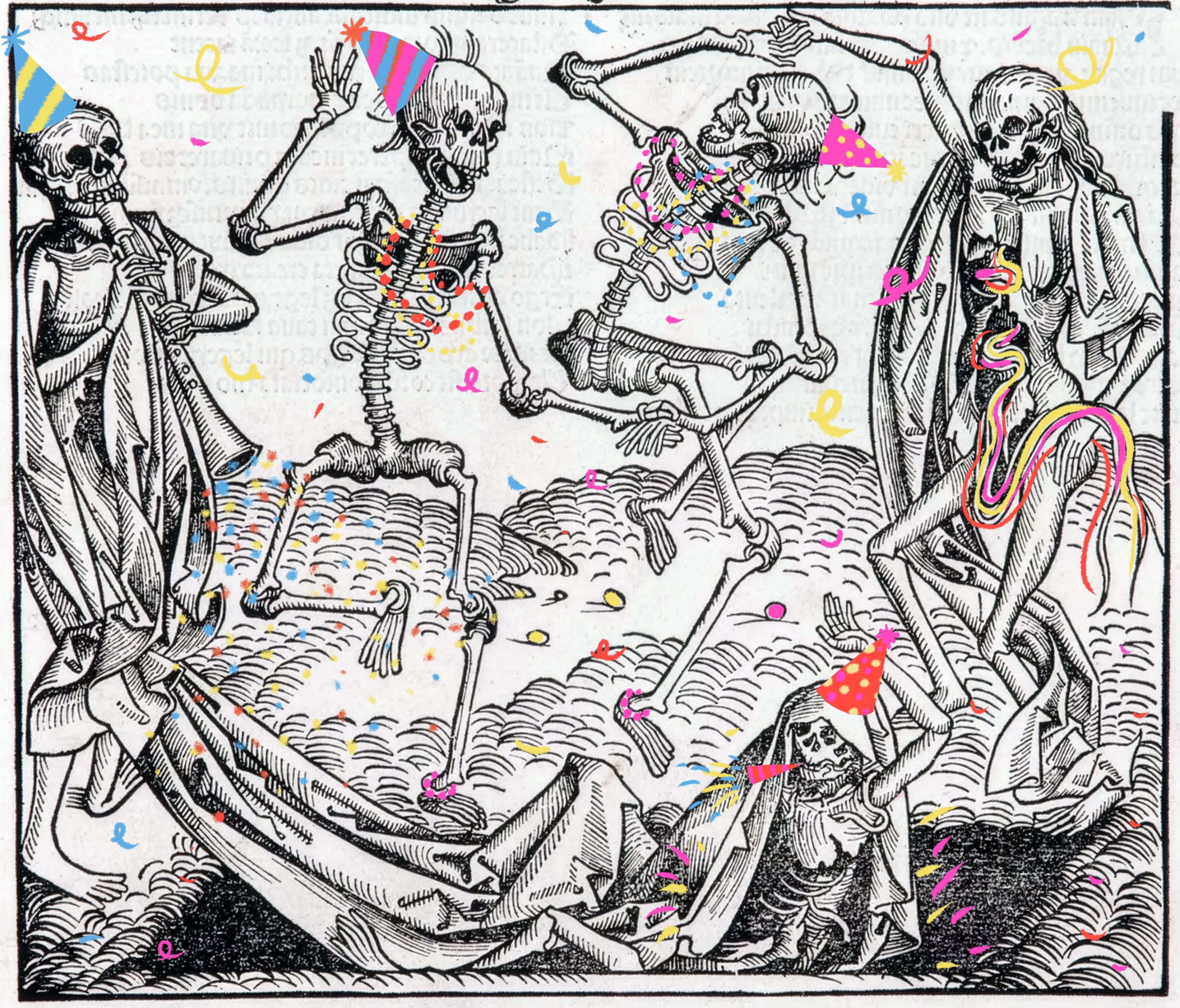
By curious paradox, death − the cause of pain, anger, sorrow and all manner of negative emotions − also gives us much of our pleasure and amusement. This may come as something of a surprise at first blush but, when you think about it, a large percentage of our entertainment involves deathly themes. We play with death and enjoy it in myriad ways.
Death is the theme of some of our family festivals and holidays, like Mexico’s Day of the Dead and Halloween. We love murder mystery novels, television series, feature films and plays. Some of us go to murder-themed parties. True-crime books and documentaries command huge audiences. Authors and filmmakers make fortunes bringing us the undead – vampires, zombies and ghosts. We happily file into haunted houses at amusement parks and join ghost tours and other deathly amusements. Until disturbingly recently, people made a party out of public executions. Today, we watch death played out on video or participate in it through video games. Ironically, we worry about how much of this our children are watching, while from their earliest years we read them fairy tales by the Brothers Grimm, with poisoned apples, grandma-eating wolves, giants who bake bread from human bones, and cannibalistic witches.
Some of these amusements have their origins in the fear of death. Halloween, for example, was once a festival designed to ward off evil spirits, not embrace them as we do today. Vampires and zombies caused genuine alarm, and ghosts were feared far more than they are now. The fairy tales gathered by the Grimms may be seen as parables to warn children to be careful with strangers or walks in the forest (though they occasionally went too far, as we shall see).
Crime fiction comes in many varieties, but all of them in some way involve the reader in a problem-solving journey. Some provide clues and challenge the reader to solve the crime; others detail the process by which the detective or forensic investigator does so. The best of them are full of interesting contextual information, and the very best of them are good literature.
The appeal of graphic violence on the screen is harder to explain, or at least the explanation may be harder to accept. That is, if the film director Oliver Stone is correct in saying: “This is what we are. We are animals…this is our Darwinian chain. We have aggression in us. This is part of our nature.” But he and others argue that feeding that atavistic nature in movies can help steer us way from violence in real life. Another director, John Carpenter, has commented that horror films can “prevent violence by offering an entertaining version of it”. A similar explanation has been adduced for the bloody “games” of ancient Rome. They came about at a time when Rome was urbanized, with up to a million people crowded together, and finally at peace after many years of war. Blood sports were developed as a safety valve for restlessness among the population.
Psychologists will naturally have many other explanations for the role of death in our entertainments, but at the root of it all is the fact that death concerns us all. This is so despite the best efforts of medical science, as the satirical publication The Onion reminded us in its 1997 report, “Death Rate Holding Steady at 100%”. This being so, it should be no surprise that it affects all aspects of our lives – love, work and play.
Festivals of Death
Today we look at festivals of death, some of the most playful celebrations in the calendar. Other examples of Playing with Death will follow over the coming months.
Dia de Muertos (Day of the Dead)
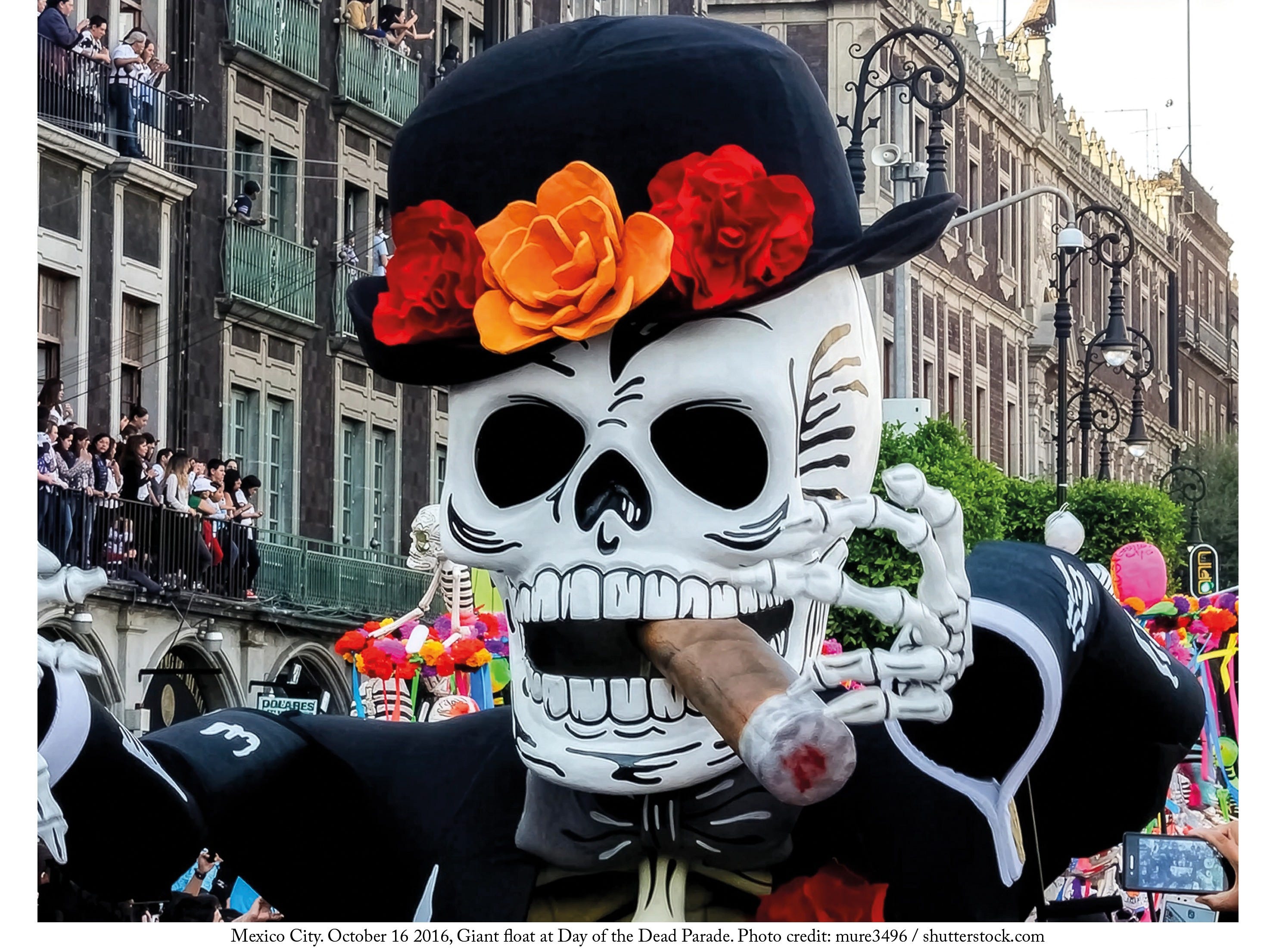
One of the most visually exciting opening sequences of all the James Bond films is the start of Spectre (2015), set in Mexico City during the Day of the Dead parade, a glorious spectacle of revellers in elaborate costumes, their faces masked or painted to look like highly decorated skulls or demons. This was clearly a flamboyant, and playful, annual celebration akin to Carnival in Rio.
Actually, no. At great expense, Director Sam Mendes created a Mexico City Day of the Dead parade from scratch. There was no such tradition before Agent 007 came to town. Understandably, most people seeing the film assumed that it was a terrific annual event and well worth seeing. Many of them started to plan trips to Mexico to be there for it. The local tourist board was smart and agile enough to jump on the opportunity and, by the following year, the Mexico City Day of the Dead parade had become an annual event.
The parade might not have been an old tradition, but the Day of the Dead certainly was. Its roots go back centuries before the arrival of the Spanish conquistadors in 1519. The Aztecs and Mayans held festivals to honour their deceased ancestors with food and flowers, believing that they could be helpful intermediaries with the gods. They also believed that the dead could inflict illnesses on the living if not treated with proper respect.
Soon after the conquest, as monks converted large numbers of native Mexicans to Christianity – 9 million of them by 1537 – pre-Hispanic traditions combined with the European tradition of All Souls Day. Like Mexico itself, Dia de Muertos is a fusion of Europe and Mesoamerica.
Mexican filmmaker Eva Aridjis describes the present-day observation of Dia de Muertos in Mexico as follows:
“Tombs are swept before offerings are laid out, and on the night of 1 November the living stay up late, talking to their deceased relatives and filling them in on the events of the past year. On 2 November, cemeteries swell as people adorn graves with flowers, burning candles and incense. A band of musicians will play anything from funeral marches to topical tunes to liven up the visiting souls, and the air hangs heavy with the sweet fragrance of copal, a pre-Hispanic incense. Tables in family homes are transformed into altars bearing the photographs and favourite dishes of the deceased… Toys are put out for dead children, and alcohol for adults. In bakeries all over the country, skulls and crossbones decorate pan de Muertos, while sugar and chocolate skulls grin mischievously from the windows of shops… There is a profusion of puppets, masks and figurines depicting Death as a laughing skeleton who dances, rides bicycles and plays musical instruments.”
Halloween
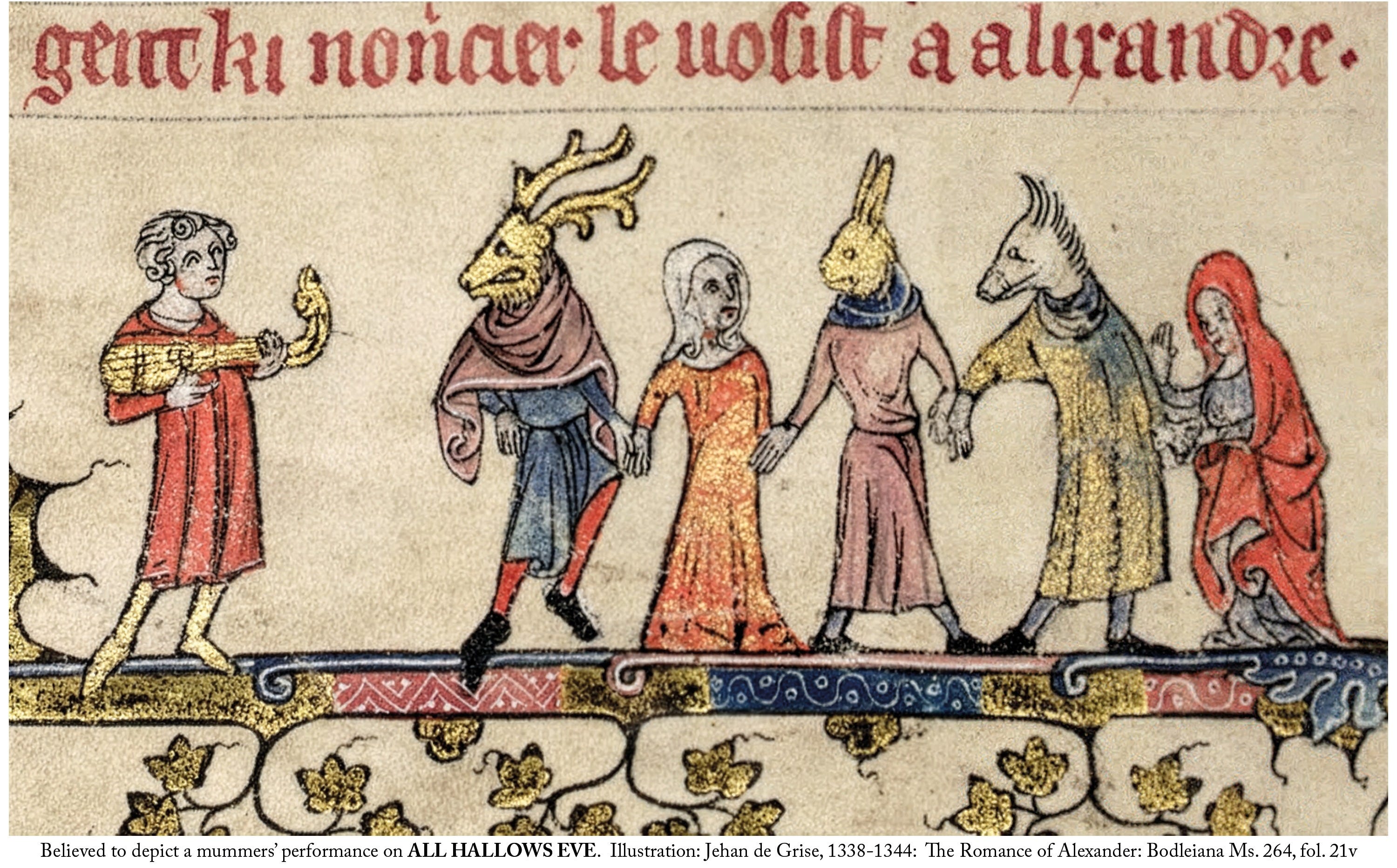
Like Dia de Muertos, Halloween has its roots in both ancient tradition and Christian practice. The Celtic festival of Samhain (pronounced sah-win) was marked after the end of the harvest, at the start of the season of longer nights and colder temperatures. For the Celts, this was the time when the boundary between the worlds of the living and the dead was at its thinnest, and ghosts walked the earth. In order to protect themselves from pernicious influences, they lit bonfires, made sacrifices of crops and animals to the gods, and wore masks and costumes to ward off demons. House fires were extinguished, and new ones lit from the sacred bonfires to keep the family safe. It was also a time for fortune-telling; since the spirits were visiting, the Celtic priests or Druids could connect with them more easily than at other times of the year.
After the Romans conquered the Celtic lands of Gaul, and later Britain, they merged their own traditions with Samhain – Feralia, a festival to honour ancestors, and the autumn harvest celebration of Pomona, the goddess of fruit and orchards. Her symbol was the apple. Apple-bobbing was incorporated into the Samhain tradition and spread beyond the lands occupied by the Romans to Ireland, and also to Scotland, where it is still known as “dookin” for apples.
In the seventh century, more than two hundred years after the Romans left Britain, the Pope established All Saints Day, to be celebrated on 1 November. It also came to be known as All Hallows Day, and the night before was All Hallows Eve, from which developed the name Halloween (or, more correctly, Hallowe’en). It was an attempt by the Catholic church to appropriate a pagan tradition, and it worked to a degree. In a precursor of today’s trick-or-treating, for example, the poor would go to the homes of the better-off and receive food – “soul-cakes” – in exchange for praying for the souls of their benefactors. The church preferred this to the pagan practice of putting food out for the spirits.
Gradually, the old traditions became entwined with the religious beliefs and symbols of the Catholic church. Religion, superstition and magic co-existed in All Hallows Eve festivities throughout the British Isles in the centuries before the Reformation. Protestantism was less indulgent of the old ways, but the observation of Halloween nevertheless continued, not only in Ireland and those parts of Scotland that were beyond the austere control of John Knox’s Presbyterians, but also in parts of Protestant England. Shakespeare referred to it somewhat disdainfully in Two Gentlemen of Verona, which was written around 1590. Speed’s comment “to speak puling (whining) like a beggar at Hallowmas” shows that the Bard was familiar with the practice of the poor seeking soul-cakes or other handouts.
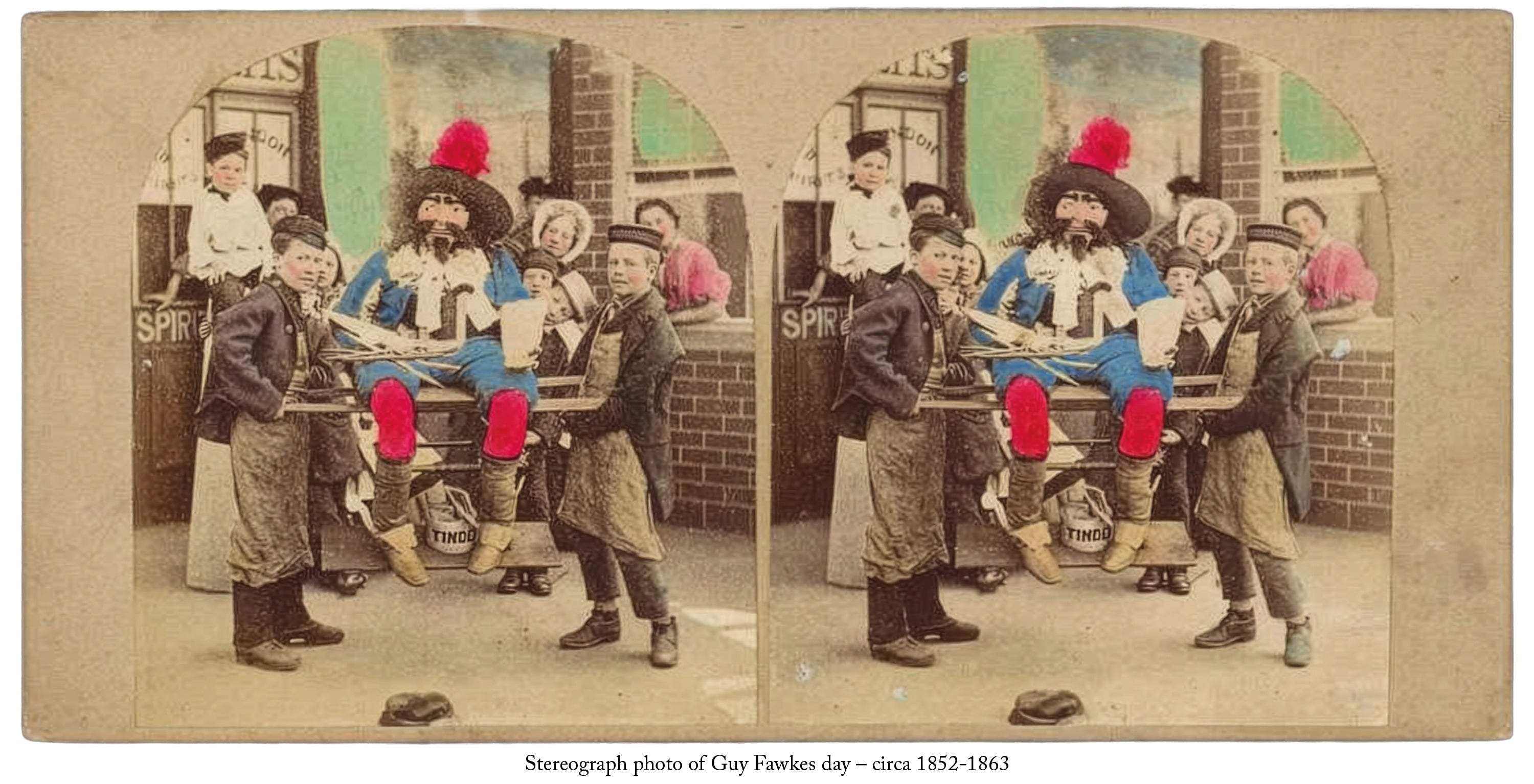
The Gunpowder Plot was a conspiracy by a number of English Catholics to blow up the House of Lords and assassinate King James I during the State Opening of Parliament on 5 November 1605. Following its failure, and the arrest and execution of the perpetrators, people lit bonfires around London to celebrate the King’s survival. Soon afterwards, an annual public day of thanksgiving was declared which, coming less than a week after All Hallow’s Eve, supplanted the old tradition. Two large bonfire-centred celebrations in such a short time would be too much for any community, and the new “Bonfire Night” offered the additional benefit of tossing a “guy” onto the pyre and watching him burn. Guy Fawkes was only one of a dozen or more conspirators, and not even the leader, but he was the one discovered with the explosives on the eve of the attack, and it is his name that every schoolchild in the country knows. Guy Fawkes Night, as it is often called, is now a purely playful event − a party with food, fireworks and fun for the kids. Never mind that the central symbol is a man burning in effigy; never mind also that the real Guy Fawkes was hanged, drawn and quartered, not burned, but we should not let that spoil the fun.
English colonists in America took both traditions with them – All Hallows Eve as well as Guy Fawkes Night (which they called “Powder Plot Day” or “Pope Day”). The Puritans of New England preferred the latter; they regarded Halloween as satanic and, like their counterparts in Cromwell’s England, they did away with most holidays and feast days. The southern American colonies were more relaxed. But it was not until well into the nineteenth century that what we now know as Halloween in the United States began to command wide popular appeal. The word is barely mentioned in American literature until the 1860s. By that time, Irish and Scottish immigrants had arrived in large numbers, bringing their Halloween traditions with them. These became integrated with the autumnal “play parties” that were already common in rural areas, featuring music, dancing, food and fortune-telling. Halloween as it is celebrated today resulted from this fusion.
Jack-o’-lanterns carved from pumpkins were an American development of the Irish and Scottish tradition of carving grotesque faces onto root vegetables to ward off evil spirits. A similar tradition existed in certain villages in Somerset in the West of England, where a Halloween variation called Punkie Night has long been celebrated on the last Thursday of October, “punkie” being an Old English word for lantern. Punkie Night also has a tradition of trick-or-treating: “give me a candle, give me a light, if you don’t, you’ll get a fright.”
Halloween is now shorn of its religious and superstitious past. It is all about play. Ghosts, monsters, ghouls, trolls, skeletons, witches, vampires and tombstones – the themes are death and evil; but it is all a game, a party for children and adults alike. And it is big business. In the United States, it has been estimated that annual spending on Halloween runs to more than US$10 billion, some $500 million of which is spent on costumes for pets.
The American-style Halloween, with its costume parties, elaborate house and garden decorations, and children trick-or-treating round the neighbourhood, has been re-imported into the British Isles where it all began thousands of years ago. The Irish now carve their jack-o’-lanterns from pumpkins, not turnips. The English enjoy both spooky Halloween parties and, five days later, fireworks on Bonfire Night. Play has triumphed over Death.
Ching Ming
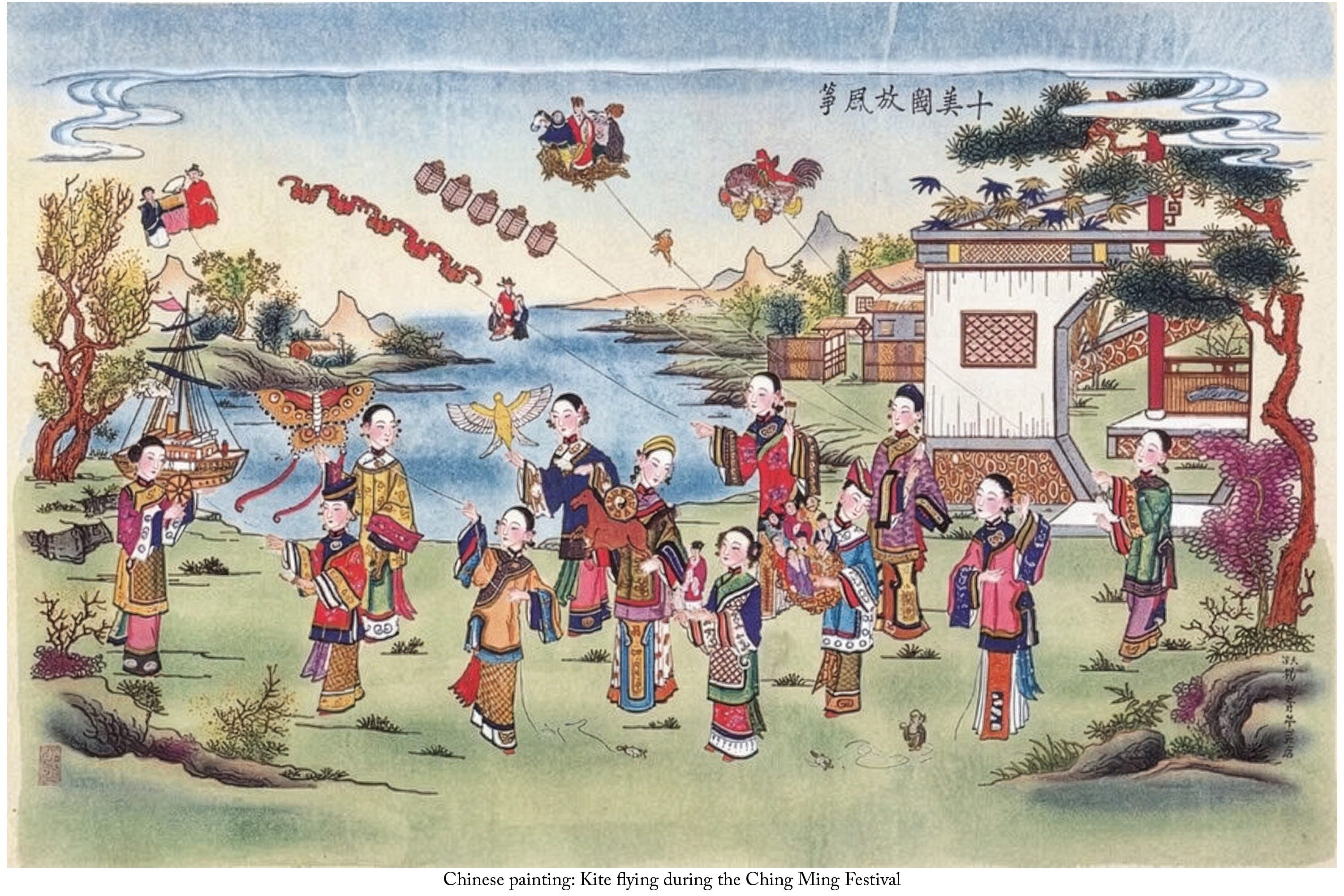
Unlike Dia de Muertos and Halloween, the ancient Chinese festival for the dead, Ching Ming (or Qingming in the pinyin romanization), occurs in the spring. It both honours the dead and celebrates new life at the start of the growing season. Although its origins are said to go back more than two thousand years, its observance as a holiday, fifteen days after the spring solstice, is attributed to a declaration by a Tang dynasty emperor in the ninth century.
Ching Ming is sometimes called Tomb Sweeping Day. Families gather at cemeteries, tidy up the gravesites of their loved ones, polish tombstone inscriptions, make ritual offerings, burn incense, and sometimes set off firecrackers to ward off evil spirits. After respects have been paid to the deceased and memories shared, the mood becomes more joyful. There are picnics and games, kite-flying and tugs-of-war. It is also a time to plant flowers and trees.
According to Juliet Bredon’s book The Moon Year (1927), the ancient Ching Ming was “an orgiastic festival of life-renewal”. The modern holiday is no saturnalia, but is a time of optimism, hope and playfulness, even as it honours the dead.
🌺💀🌺