

Playing With Toy Soldiers
Harry Pearson on how the cultural landscape was littered with literary wargamers.

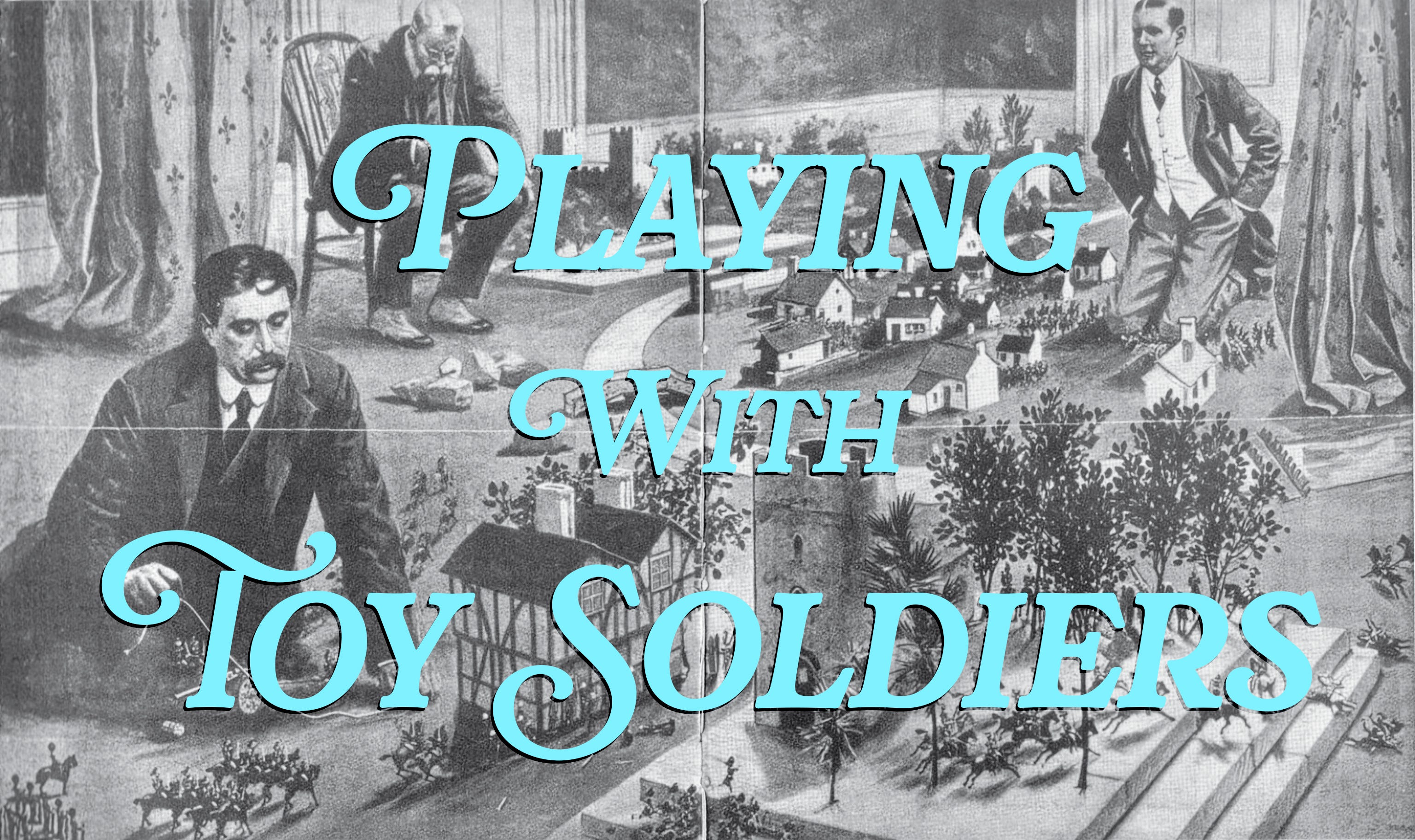
“Number 999 in the vast library catalogue of books I have never written,” wrote G.K. Chesterton in his autobiography, “is the story of a successful city man who seemed to have a dark secret in his life; and who was eventually discovered playing with tin soldiers... I may say that I am that man in everything except his successful business career.”
The creator of Father Brown was hardly unusual, in this respect at least. For centuries, the fear of being discovered ‘playing with toy soldiers’ is one that has haunted men of Chesterton’s persuasion. Such individuals have traditionally attempted to deflect outside criticism by rebranding their toys as ‘models’ and framing their ‘play’ within systems of rules so complex and arcane they would give a nuclear physicist a migraine. Although they may assure the world that what they are doing is not playing but ‘simulating’, that theirs is a scientific branch of military study, still the terror of discovery and humiliation hangs over them. I know. I am one.
Yet had G.K. Chesterton chosen to come out to the world, he would certainly have found support amongst his contemporaries on the British literary scene. The nineteenth- and twentieth-century cultural landscape was awash with novelists, playwrights, historians and journalists who liked nothing better than setting up their toy soldiers on the living room floor and seeing if they could reverse the result at Yorktown, Minden or Waterloo by knocking them over with spring-loaded cannon fire, or dice rolls.
Surprisingly, given the prevailing attitudes of the time, the first great literary war-gamers were not men, but girls. The Brontë sisters’ obsession with toy soldiers began when their father returned home late one night from Leeds with a box of wooden figures known as biffins. As Charlotte would recall in her memoir A History of the Year 1829: “Next morning Branwell came to our door with a box of toy soldiers. Emily and I jumped out of bed, and I snatched up one and exclaimed, ‘This is the Duke of Wellington! This shall be the Duke.’ When I said this, Emily likewise took one up and said it would be hers. Mine was the prettiest of the whole and the tallest, and the most perfect in every part. Emily’s was a grave looking fellow, and we called him ‘Gravey’. Anne’s was a queer little thing much like herself, and we called him ‘Waiting Boy’. Branwell chose his and called him ‘Buonaparte’.”
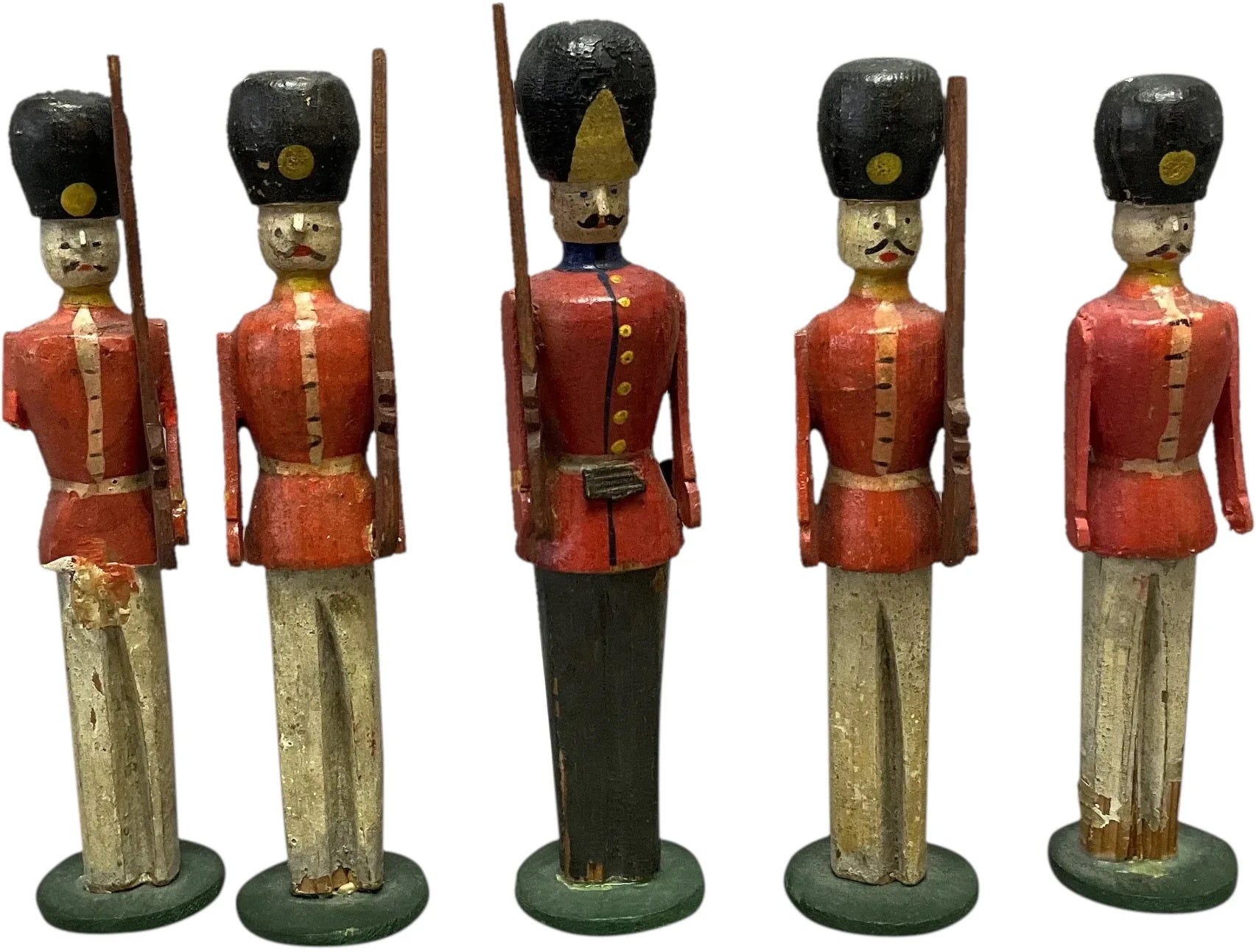
The soldiers and the later boxes that were added became part of an elaborate game involving battles, rebellions and encounters with fiery monsters in an imaginary kingdom named Angria. The chronicles of the games were recorded in tiny hand-made books by Angria’s own historian, a carved soldier the Brontës called Captain John Bud. Angria also had a national poet, a figure belonging to Branwell and named Young Soult after one of Napoleon’s greatest marshals, Nicolas Jean de Dieu Soult. The Angria campaigns would become the Gondal Saga, which Anne and Emily would write about throughout their lives. Whether the Brontës’ games had written rules or were purely imaginative is not recorded. Perhaps they were a combination of the two – a Georgian parsonage version of Dungeons and Dragons (itself the inspiration for the best-selling Dragonlance novels of Laura and Tracy Hickman and Margaret Weiss).
In the 1850s, the nurseries of wealthier English children were transformed by the arrival of a new breed of toy soldiers. They were solid, between 30mm and 40mm high, cast of tin alloy and made in Germany, principally by the companies of Allgeyer and Heinrichsen. The German companies produced a vast range covering a huge variety of periods and featuring infantry, cavalry, artillery and even armoured trains. It says something for the impact they had that Allgeyer’s toy soldiers are even mentioned by name in Thomas Pynchon’s Gravity’s Rainbow, though whether the experimental American novelist ever played with any is an open question.
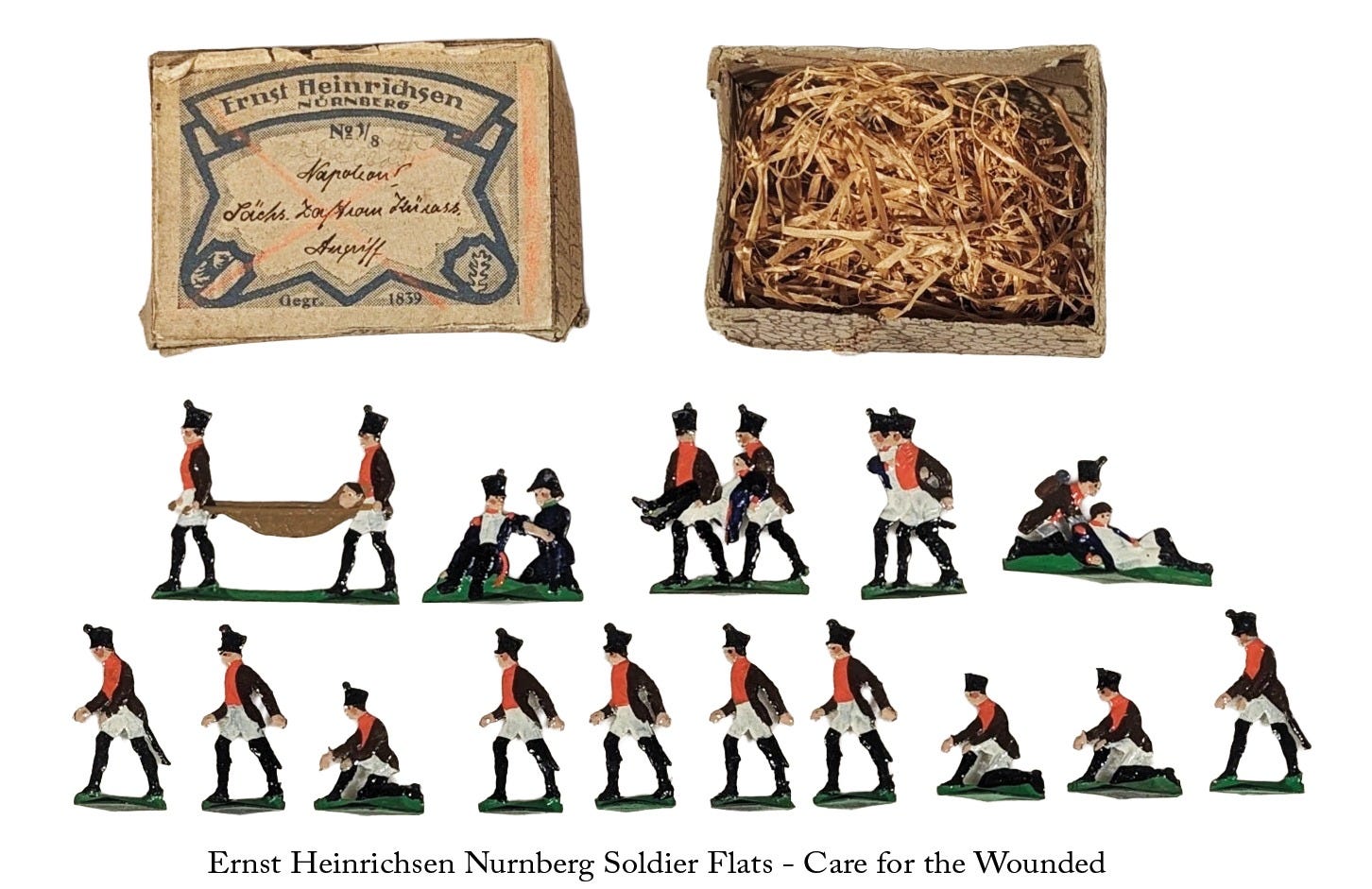
It was these German tin soldiers that found their way to the attic of Robert Louis Stevenson while he was convalescing from illness at Davos in 1881. The author of The Strange Case of Dr Jeckyll and Mr Hyde was soon using them to fight a series of large-scale battles with his stepson, Lloyd Osborne. According to Osborne’s later account (Stevenson at Play) the rules were elaborate and a single battle could take weeks to complete, the soldiers manoeuvring across a map drawn on the floor with chalk, with each individual figure representing a real-life regiment. The details of the encounters were published by the great Scots writer in a home-made newspaper called the Yallobally Record, which presented a thoroughly biased account of affairs in which Stevenson’s armies were always gallant and bravely led, but those of his opponent a cowardly mob commanded by an incompetent poltroon. Stevenson’s rules were probably based on Kriegspiel – the military game used to train Prussian officers in battlefield tactics and played in Germany using wooden blocks on a map − and were constantly being tinkered with in an attempt to reach perfection. What became of them is a mystery.
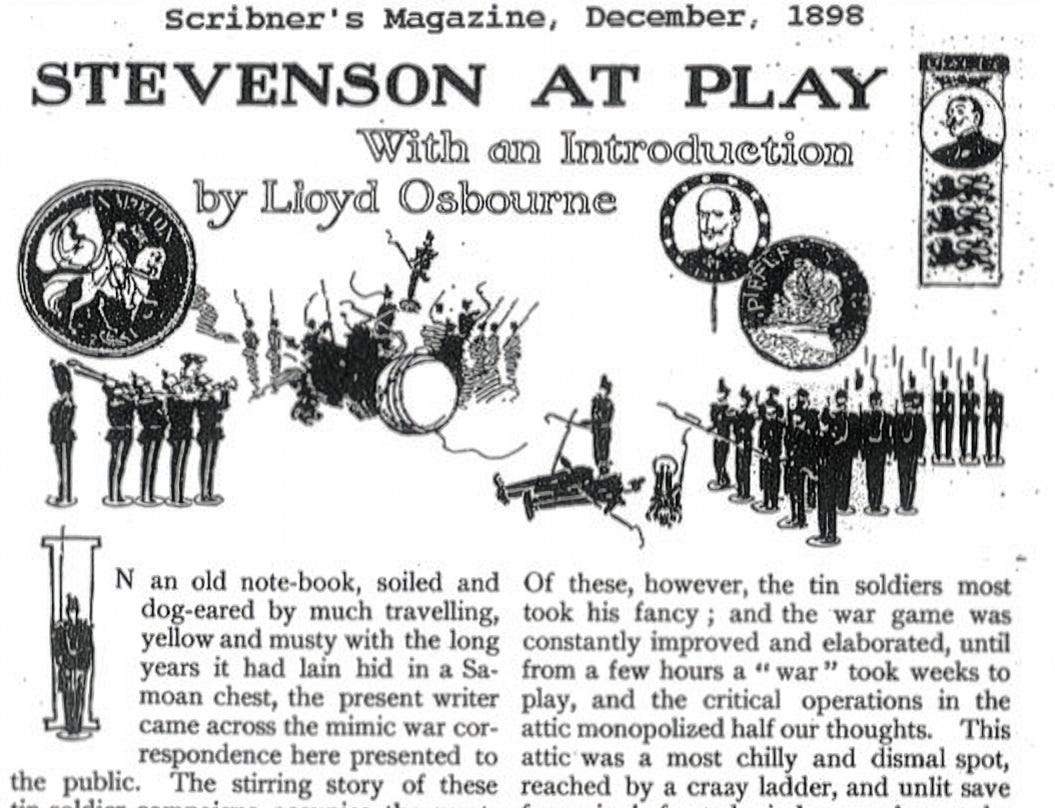
Possibly the greatest buyers of the new German toy soldiers were three brothers, Charles, Robert and George Trevelyan, who lived at Wallington House in Northumberland. Over the course of five or six years, the trio accumulated a collection of over 4,000 Allgeyer and Heinrichsen figures from a dealer in Burlington Arcade. They used them to refight historical battles on the living room floor (the Duke of Marlborough’s great victory at Blenheim was a particular favourite). Lasting for several days, the games were played using elaborate rules that, like Stevenson’s, were based on Kriegspiel. George Trevelyan went on to become one of Britain’s leading historians, attributing his ability to describe battles to the days spent war-gaming on the carpets of Wallington (where the collection of toy soldiers the brothers played with can still be seen). Charles became a Liberal MP and campaigned to keep Britain from entering the First World War. Robert turned to poetry; a member of the Georgian group, he was a friend of Rupert Brooke and Edward Thomas − both of whom would die in the conflict his brother had opposed.
The next great boost for the literary carpet-general came with the arrival on the toyshop shelves of a new wave of recruits made in North London by W.M. Britain. Britain’s toy soldiers were hollow-cast, a process using less metal, which meant they were lighter and cheaper than their German rivals; they were also taller, at 54mm. The first Britain’s soldiers went on sale at Gamages department store in Holborn in 1893 and proved an instant hit.
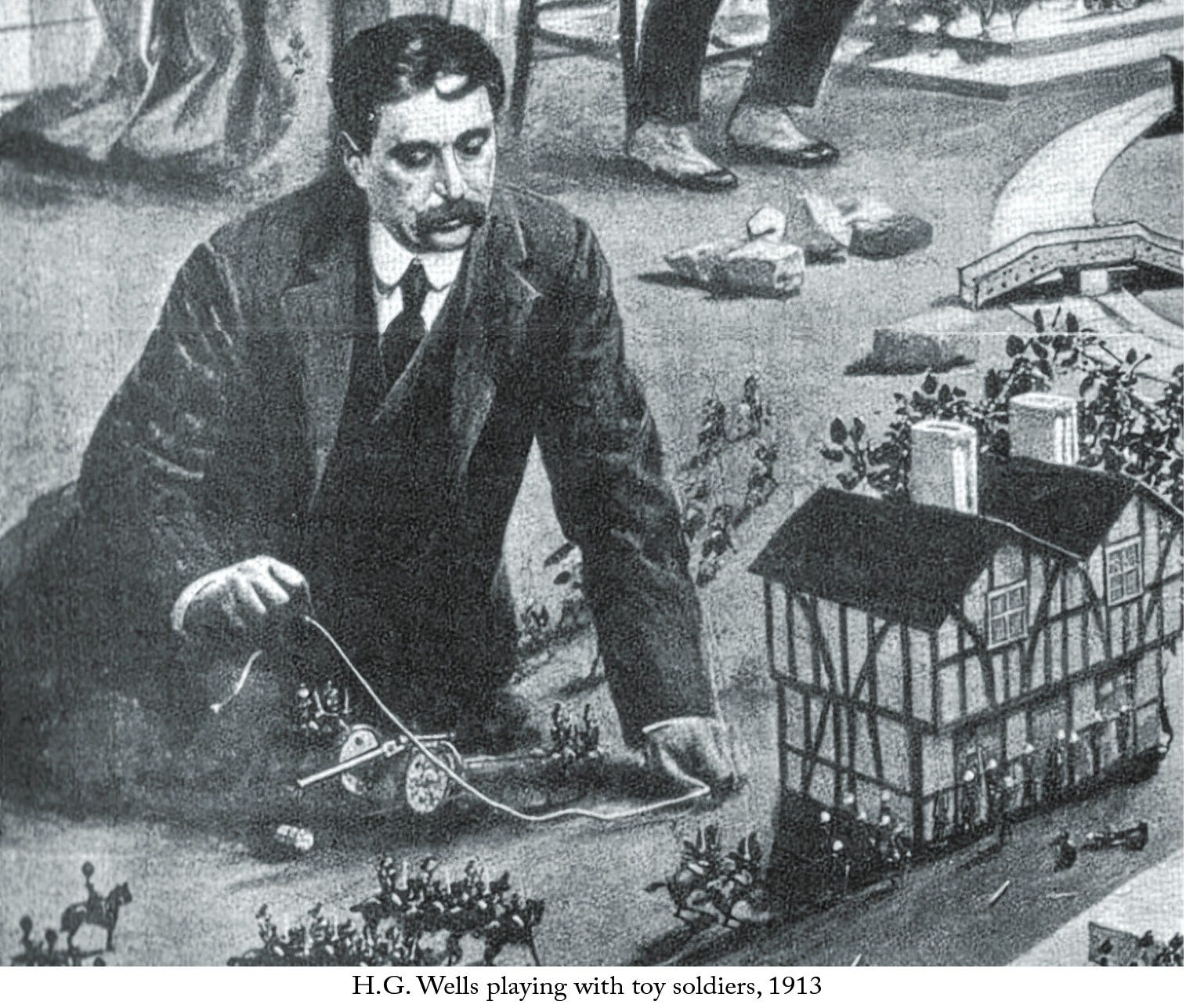
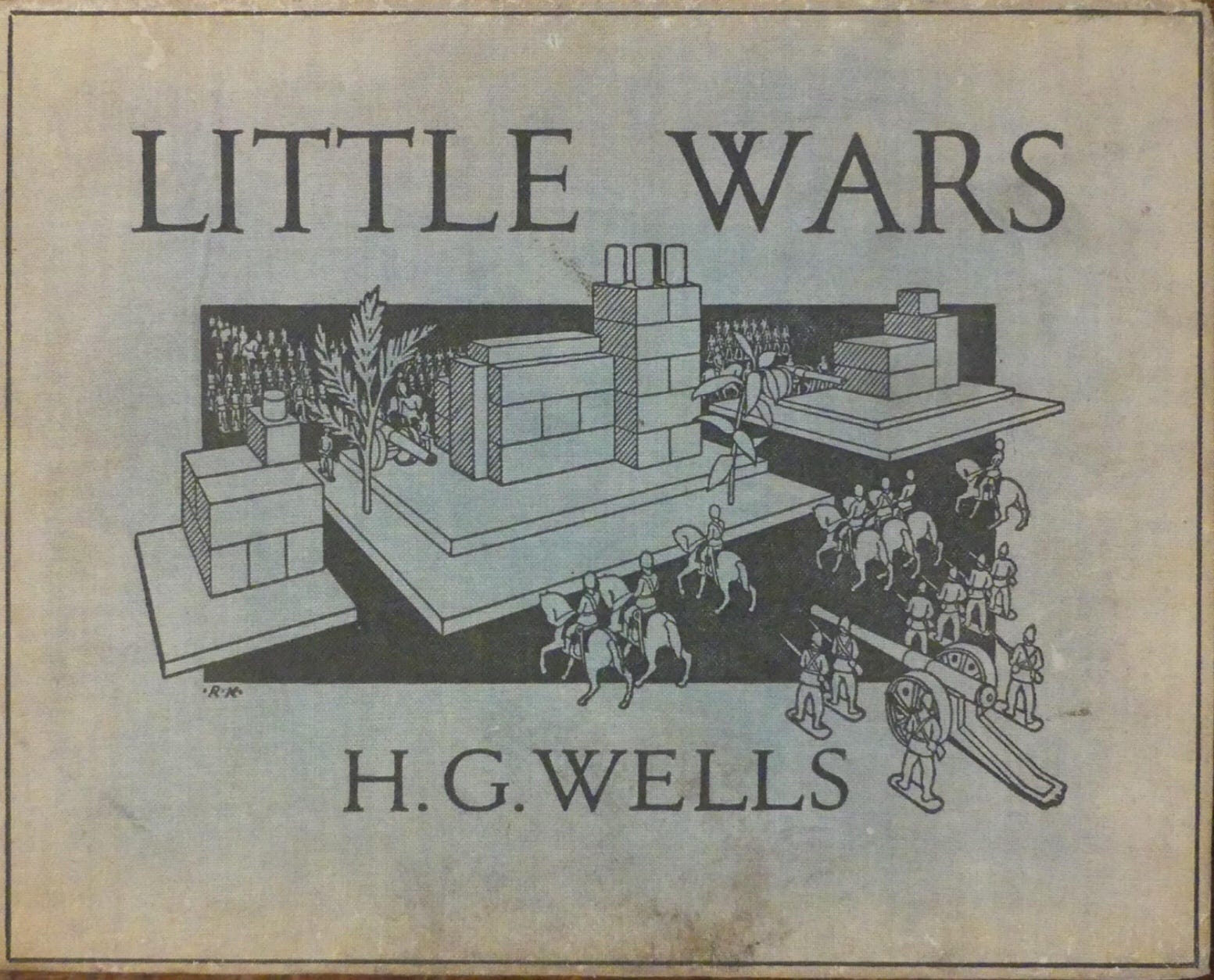
It was these new, sturdy British toy soldiers that inspired H.G. Wells to start fighting battles in his drawing room. His opponents were his two sons, as well as publisher Frank Palmer, the great Edwardian humourist Jerome K. Jerome, novelist George Gissing and author and ghost-hunter Robert Thurston Hopkins. Wells’s second wife, Jane, took photos, while the Swiss governess, Mathilde, was left to tidy up the mess afterwards. The games played by the Trevelyans had been rather serious affairs, with results of combat calculated via mathematical equations (as they are in modern miniature war-games). Wells’s games were much more fun – gunfire was simulated by shooting metal rods from Britain’s range of field guns at the toy formations, who might find shelter behind hills made from piles of books. Palmer enjoyed the games so much that he suggested Wells write about them. The author had briefly described his toy battles in his 1911 novel The New Machiavelli; now he devoted two works to the topic: Floor Games and its hugely popular sequel Little Wars. This was billed as being ‘A game for boys aged from twelve to one-hundred-and-fifty and for that more intelligent sort of girl who likes boy’s books and games’. It included the rules and tips on creating armies and battlefields. Wells had never served in the army, and was no militarist. Indeed, his main aim in writing the books was to foster pacifism amongst British youth. This may appear counter-intuitive, but the author reasoned that when children discovered how destructive their toy battles were, they would see how ruinous the real thing must be. Sadly, his target audience would discover that soon enough for themselves. Little Wars was published ten months before Kaiser Wilhelm’s armies marched into neutral Belgium.
While the carnage of the First World War dampened the enthusiasm of Wells and Jerome for playing with toy soldiers, it positively encouraged other authors. A.J.A. Symons was a dandy and epicure. He co-founded the British Food and Wine Society with André Simon. He also wrote one of the most extraordinary books of the twentieth century, The Quest for Corvo, the biography of the mysterious novelist, conman and fantasist Frederick Rolfe, aka Baron Corvo. The Quest for Corvo is widely regarded as one of the greatest biographies ever written (The New York Times called it ‘a masterpiece’), yet Symons never wrote another book. According to his brother, the crime writer Julian Symons, he was too easily distracted by trivial things: musical boxes were one, playing with toy soldiers another.
Symons had begun with Little Wars style games with Britain’s figures before the First World War began. During the conflict he served in the Artists’ Rifles, and when the war ended took up playing with toy soldiers with renewed vigour. His great influence was his pal Captain Harold Fisher, who had won the Military Cross for gallantry in 1918 while with the British Salonika Army in Macedonia. He seems to have spent much of the time when he wasn’t really fighting in thinking about pretend fighting. This was not as unusual as it might seem. Brigadier Peter Young, the most decorated British officer of World War Two, was also an enthusiast for ‘playing with toy soldiers’ and wrote – with his comrade, Lieutenant-Colonel James Lawford − a charming book on the topic Charge! Or, How to Play War Games. Young’s view seems to have been that war would be jolly good fun, if only it wasn’t for all the death and misery. A fallen toy soldier left no tin widows or lead orphans. Little Wars had a romance totally absent from Big Wars.
While in the trenches, Captain Fisher had invented his own version of Kriegspiel: played on Ordnance Survey maps, using metal pieces he had specially cast to represent infantry, artillery, cavalry and armoured vehicles and aircraft. The rules were so complex it is said it took him close to a fortnight to explain them to Symons, and Symons was a very clever chap. The two men then engaged in a massive campaign that lasted for more than a year and left them both sated. In 1933, a refreshed Symons attempted to revive the game, but was disappointed to find that not even his most intelligent friends could comprehend the rules.
It was not only in Britain that playing with toy soldiers enjoyed a vogue amongst literary men. In Sweden Ossian Elgström, whose books on the lifeways and folklore of Lapland were considered minor masterpieces by his fellow countrymen, produced a book called Hur Man For Krig Med Tennsoldater (How To Make War with Tin Soldiers), which was published around the same time as Little Wars. Like Wells, Elgström favoured action over mathematics, and his book is filled with diagrams showing how to construct siege catapults and cannons that fire dried peas. Amazingly, a German translation was published in Berlin in 1916.
In the USA too there was significant action on the kitchen tables and bedroom floors of the literati. Born in 1897, Fletcher Pratt was a small, busy man with a ginger moustache who’d boxed professionally, worked as a librarian and translated the Icelandic sagas into English. Pratt wrote dozens of historical works as well as hundreds of science fiction and horror stories for the sort of ‘roaring twenties’ pulp magazines that also published H.P. Lovecraft and Robert E. Howard, creator of Conan the Barbarian. Such was Pratt’s prodigious output, it is said he was often writing half-a-dozen books simultaneously. Despite his workload, Pratt also found time to design a set of rules for fighting naval battles with model ships that are still used enthusiastically to this day in a club for like-minded men, which turned out to include feted sci-fi author Isaac Asimov. When H.G, Wells’s Little Wars was re-issued in the USA in the 1970s, Asimov wrote the introduction.
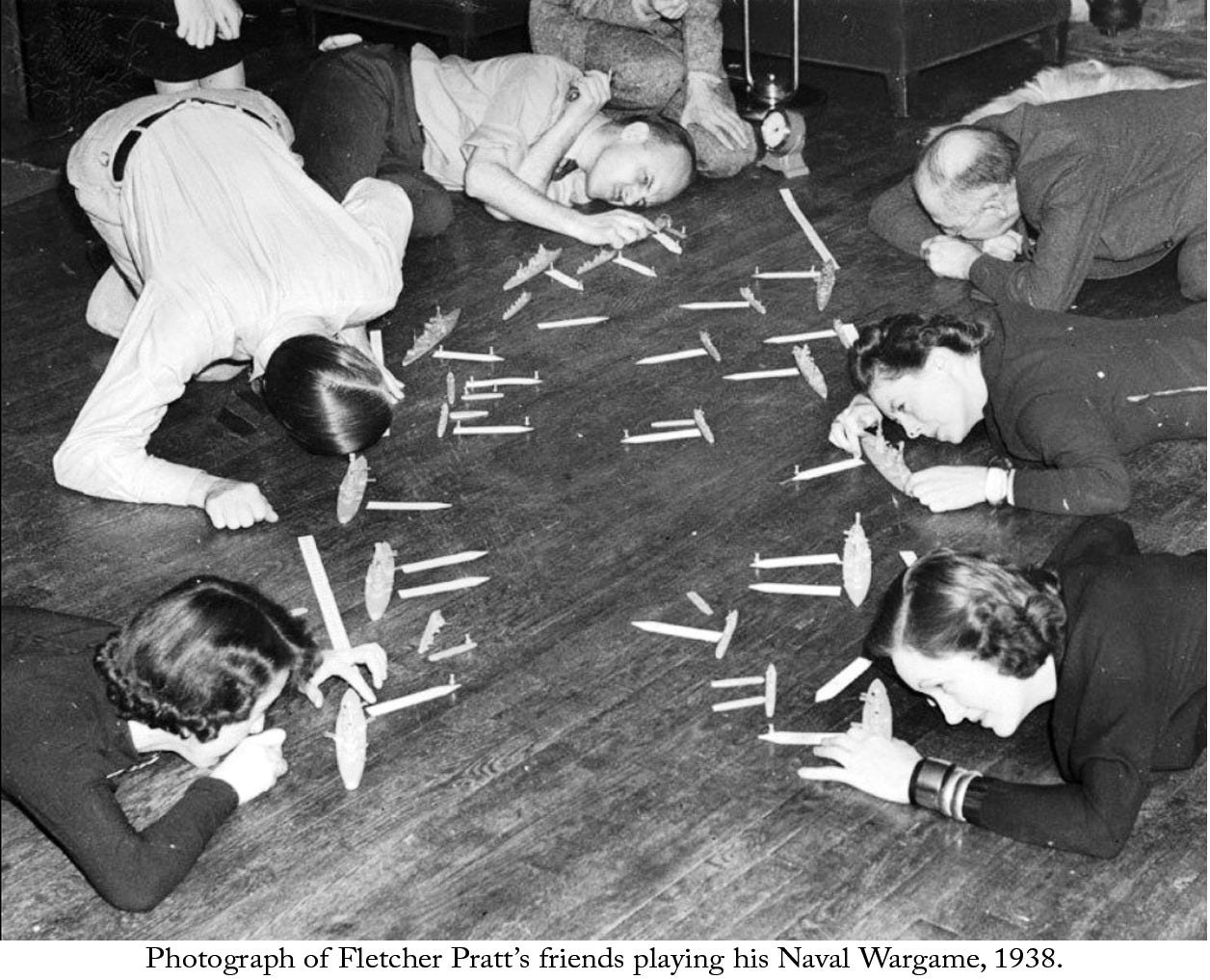
One of the descendants of Fletcher Pratt’s naval warfare rules is Harpoon. Published in 1980, Harpoon would help create one of the behemoths of modern publishing, Tom Clancy: because it was playing games of Harpoon that helped Clancy map out the plot for his first bestseller, The Hunt for Red October.
What drew these literary figures to playing with toy soldiers? Surely it was the attractiveness of the models themselves and the narrative games and storylines they invoke? Handling and playing any toy brings it to life (which is why the rows of ‘mint and boxed’ toys on the obsessive collector’s shelves appear so sterile), more so when the imagination is added to the toy’s deeds. Like the Brontës, Robert Louis Stevenson recorded in detail the bravery and cowardice of individual toy soldiers in his attic battles. He wrote back stories for his generals that motivated their deeds and actions. The outside world might dismiss this as whimsy, but there was more to it than that. A child forms a bond with his or her toys, and a residue of that feeling remains in adulthood. We give our toys life and in return, as Anatole France noted in On Life and Letters, they give us ‘joy and forgetfulness’.
When Wells and Jerome began their battles on the living room carpet, their friend J.M. Barrie’s Peter Pan had recently opened in the West End. The play was a huge hit. Little Wars reflected some of Peter Pan’s wilful refusal to grow up. Unlike the Prussian officers, Wells did not play military games because he wanted to be a general, but because he wanted to be a boy again, or at least to be boyish. Cultural historians have linked this Peter Pan-ism to the heavy burden of manhood in the Edwardian age. It was an era when masculinity carried such responsibilities of duty and honour, alongside the financial burden of single-handedly supporting a household, that they had brought this problem on themselves by marginalising women; this was an irony the patriarchy missed. As a consequence, men shrank from adulthood and pined for the warmth and irresponsibility of the nursery.
Though that may well be true, such desire persists in our more liberal and forgiving times − as the number of adults in Hogwarts scarves and Harry Potter glasses who queue up each day next to Platform 9¾ at King’s Cross Station testifies. The desire to return to a comforting world of simple childhood imaginative play is both universal and eternal. G.K. Chesterton may have been embarrassed by the games of Little Wars that he played with his brother Cecil, but he was far from alone − either then, or now.
Love this. For closet wargamers with Napoleon fantasies, it's rather reassuring.
Excellent article, reminding me of my one and only wargame experience, organized by my military history tutor at Oxford in 1975. We were gaming the Helder landing of 1799. I was the admiral in command of the fleet, and my only notable decision was to order the evacuation of the army after the general had screwed up and failed to secure the beachhead. (The 1799 commanders did a much better job of it - the landing at least but not the rest of the war)