

PlayTime with Jacques Tati
Bob Peirce on the inimitable filmmaker who viewed all life through the lens of play

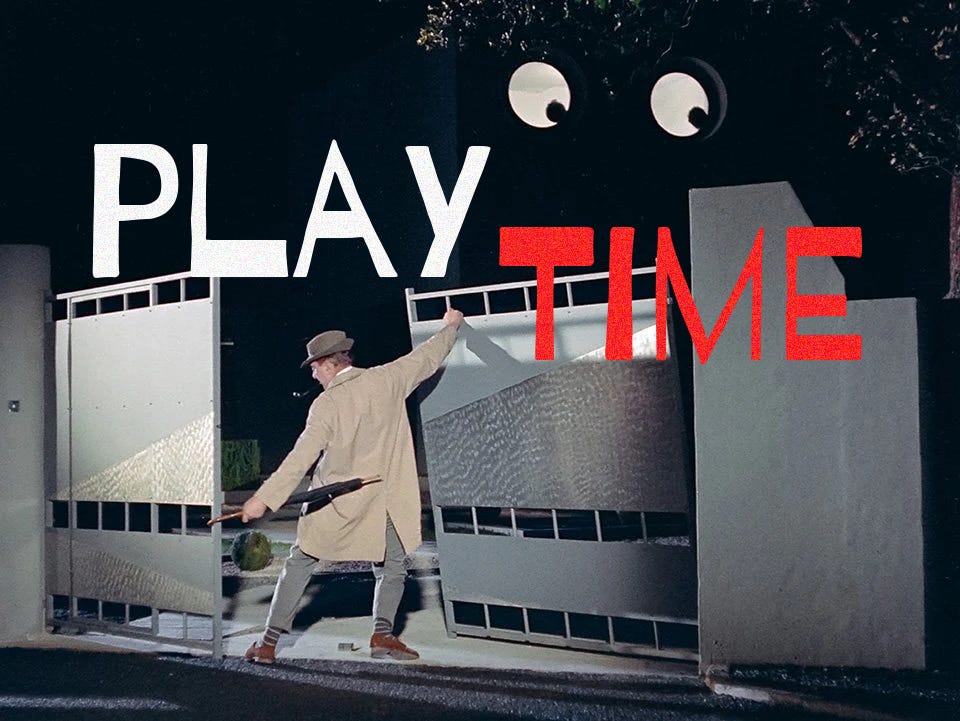
PlayTime (1967), Jacques Tati’s fourth feature film, was a commercial disaster. He made only six features in total, yet he is consistently ranked by critics and directors alike among the top fifty filmmakers of all time. PlayTime has proved to be an acquired taste, but it is a taste worth acquiring. In his masterful study of Tati’s films, also entitled PlayTime (2020), Malcolm Turvey shows why. And the key to understanding Tati is in the title.
Tati once said in an interview, “I feel sad because I have the impression that people are having less and less fun.” He disliked the uniformity and standardisation he saw in the rapid modernisation of post-war France, the pressures to perform and conform − the ‘authoritarianism’ of a homogeneous society, as he put it. But his response was not to rage against it, but to poke fun. He wanted to encourage viewers “to adopt a playful attitude towards the modern world”.
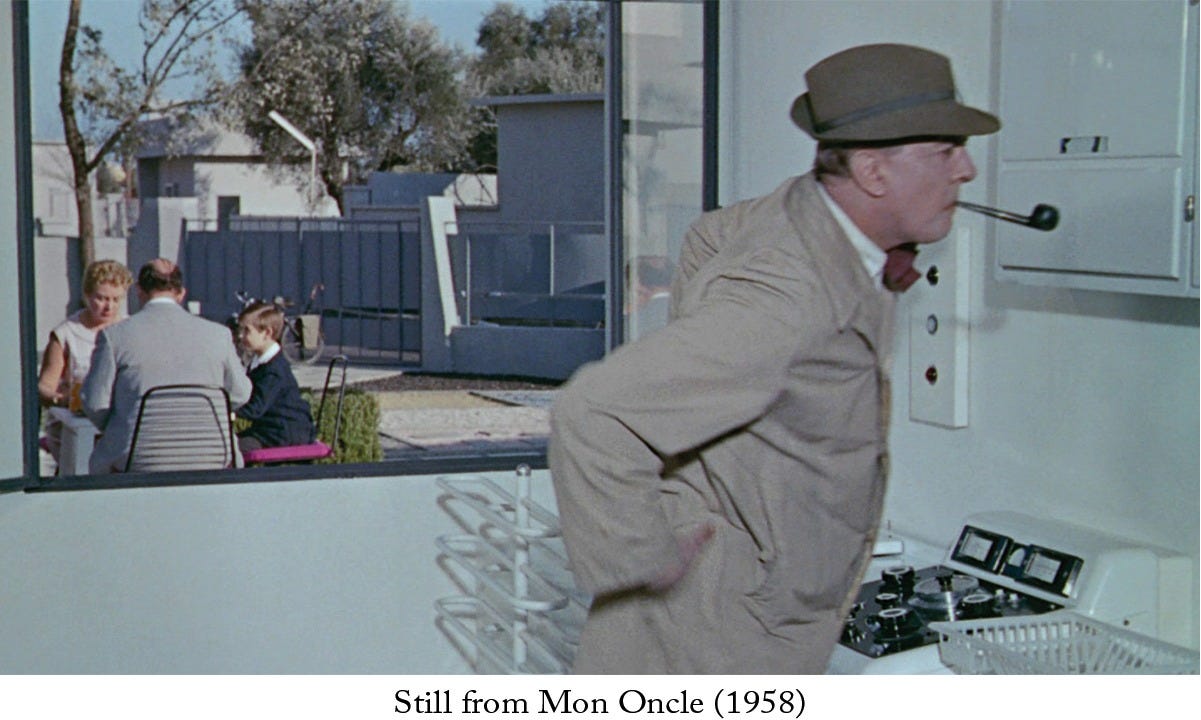
When Mon Oncle (1958) won the Academy Award for the best foreign film, Tati was asked who he would like to meet while he was in Hollywood. He chose Buster Keaton, Mack Sennett, Harold Lloyd and Stan Laurel. These elderly stars, masters of mime and physical comedy from the age of silent film, vaudeville and music hall, had been his inspiration. The characters he created for his feature films, François the postman and Monsieur Hulot, owe much to those early stars and to Charlie Chaplin (who had left America a few years before Tati’s Oscar to escape J. Edgar Hoover’s paranoid pursuit of alleged Communist sympathisers). To watch Monsieur Hulot’s gangling, loping, awkward movements and contortions is to be reminded that Tati’s performing career began with mime.
Tati was born Jacques Tatischeff in Paris in 1907. His grandfather was a Russian nobleman and army general who came to France as military attaché at the Russian embassy. His maternal grandfather, a Dutchman and friend of Vincent Van Gogh, had a picture framing company. Tati’s father joined the family business and, at the age of sixteen, so did Jacques. A keen sportsman, Tati took up rugby in his twenties, playing for the prestigious Racing Club de France. It was there that he discovered his comedic talents, entertaining his clubmates with mime impressions of various sports, including tennis, boxing and horse-riding (using his long legs to imitate the movements of both horse and rider).
When the Depression hit France in the 1930s, Tati left the relative safety of the family business to try his luck as a music hall entertainer, and quickly found success. The writer Colette described him as:
“… this amazing performer, who has invented something quite his own … partly ballet, partly sport, partly satire and partly a charade. He has devised a way of being the player, the ball and the tennis racquet, being simultaneously the football and the goalkeeper, the boxer and his opponent, the bicycle and the cyclist. Without any props …”
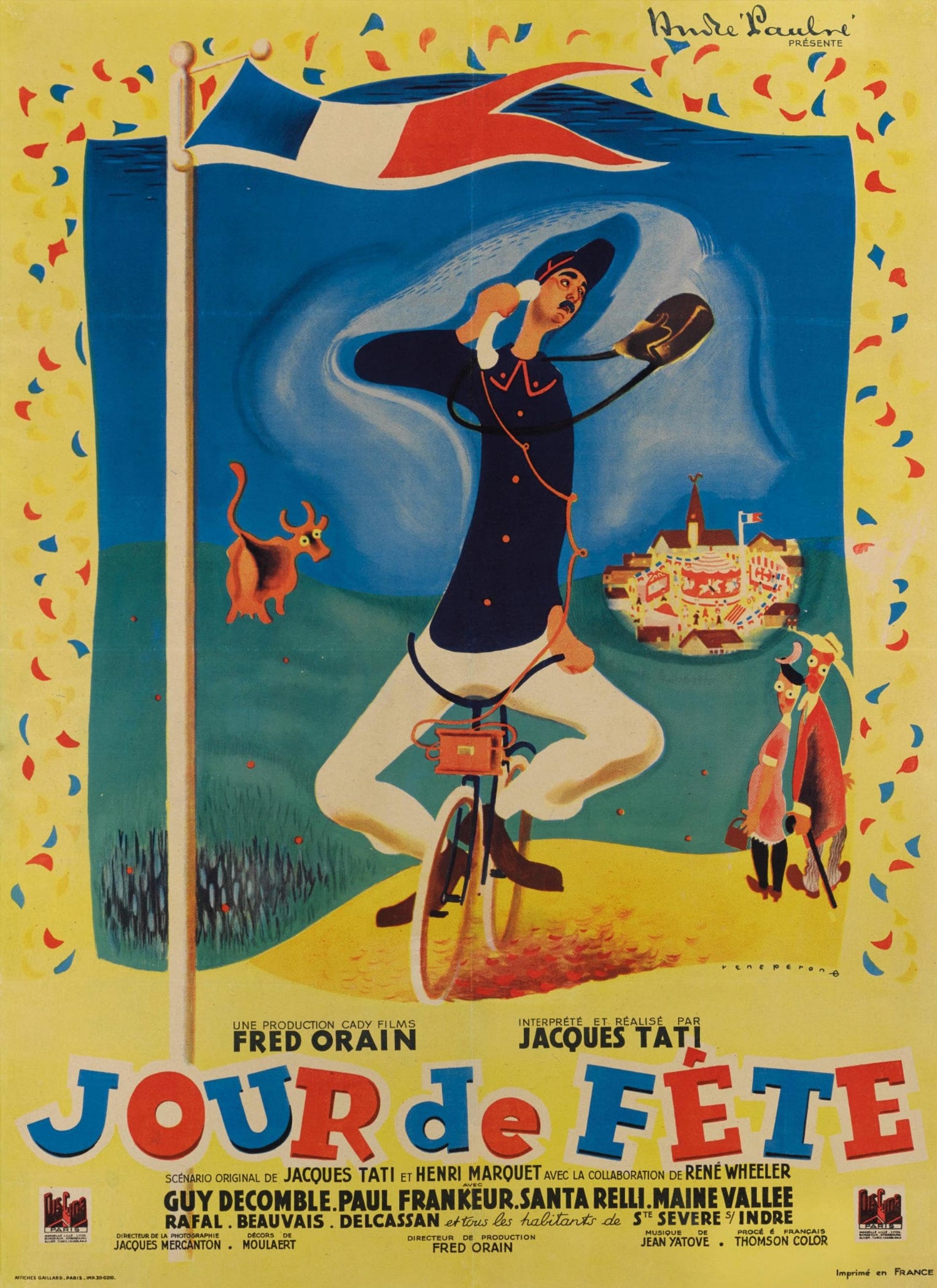
Tati acted in a few short films in the 1930s, but it was only when he was in his forties, after the Second World War, that he began his career as a filmmaker. His first feature film was Jour de Fête (1949), about the day the travelling fair comes to a small rural village. Tati directed the movie and starred in the role of François the postman, an affable, bumbling character whose every move holds the promise of a mishap, and more often than not results in one. After watching a documentary about the efficiencies of the US Postal Service, François tries to raise his own game, riding his bike at twice his normal speed and dropping off mail without stopping to talk to villagers or join them in a glass of wine. The experiment does not last. As an elderly villager tells him, “the Americans can do as they please, but it won’t make the crops grow faster”. The fair leaves town and the relaxed pace of French country life and mail delivery returns.
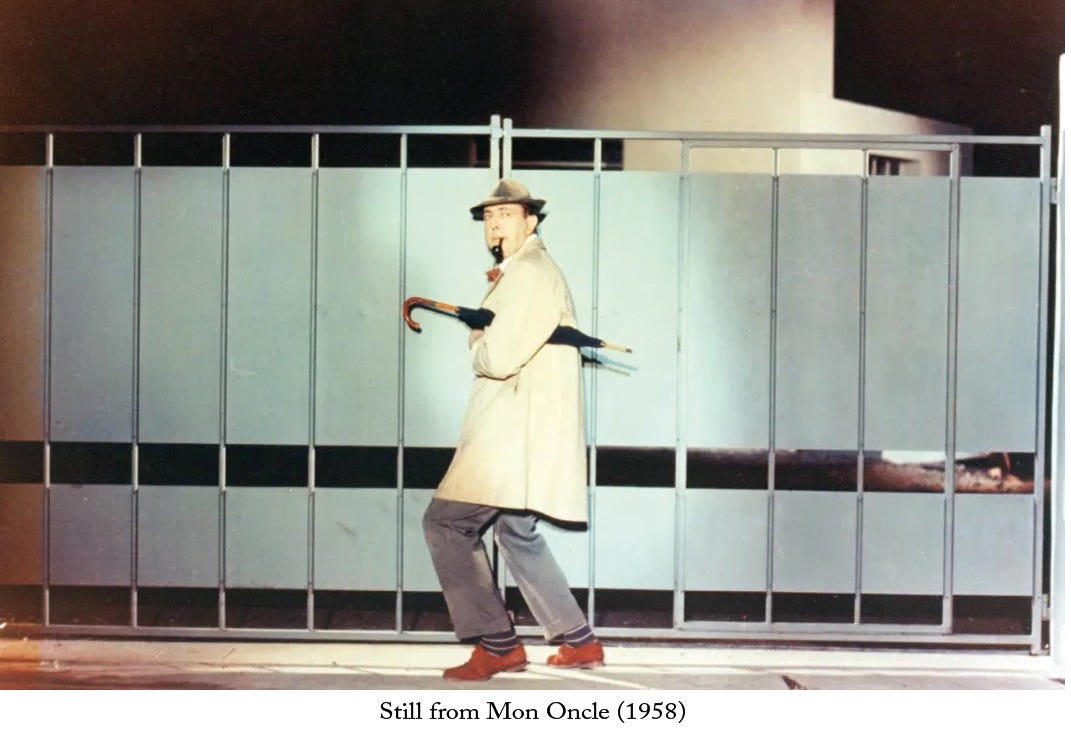
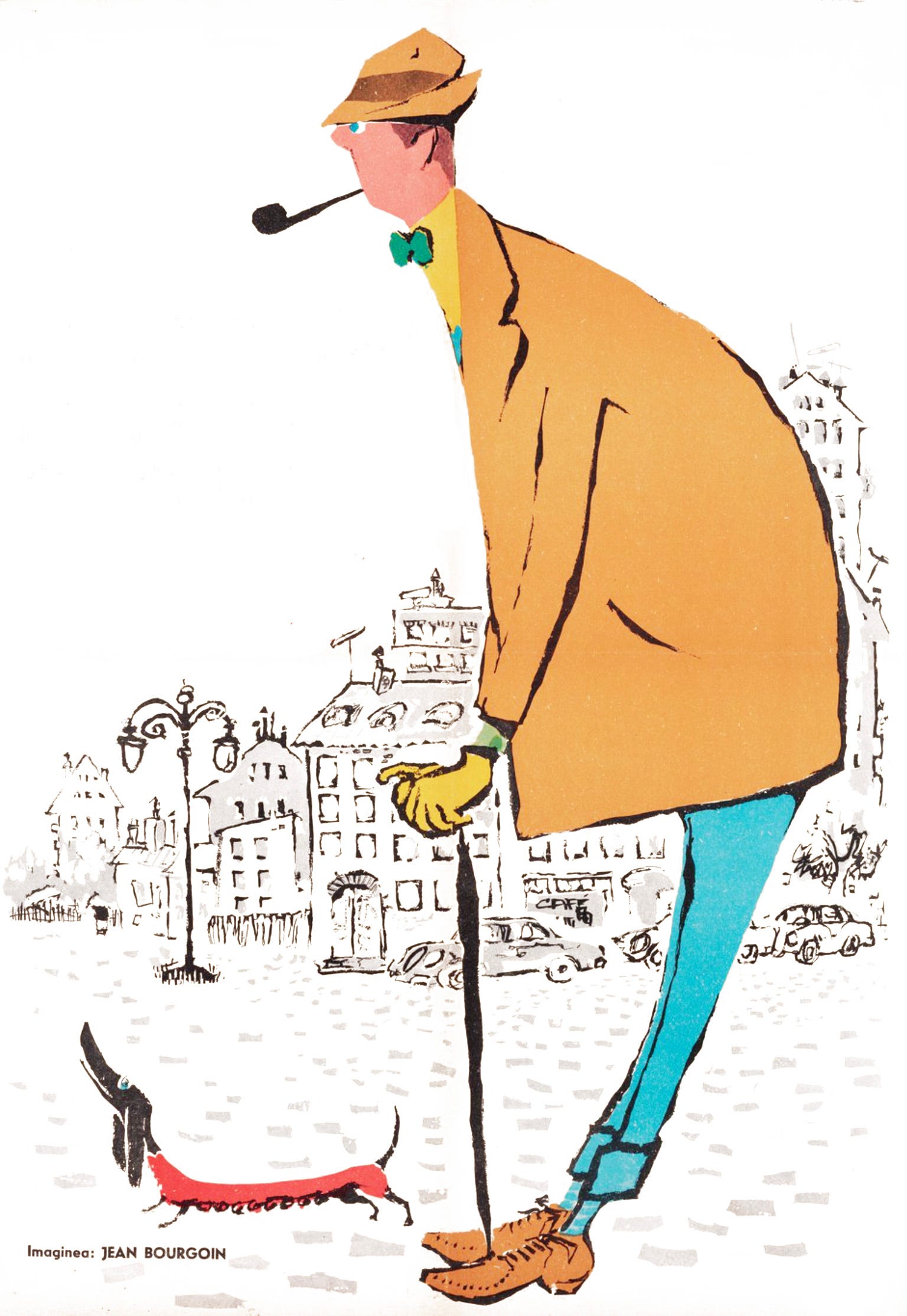
Tati is best known for Monsieur Hulot, the character he played in his next four feature films – Les Vacances de Monsieur Hulot (1953), Mon Oncle (1958), PlayTime (1967) and Trafic (1971). Hulot − with trademark raincoat, pipe and furled umbrella − is often compared to Chaplin’s Little Tramp. Like the Tramp, he finds himself out of place, awkward in social situations and struggling to come to terms with the modern world. Like the Tramp, he follows in the old tradition of ‘playing the fool’, by which a foolish, or seemingly foolish, character is used to make observations about society and expose its absurdities.
Hulot is playful, curious and easily distracted. Unlike the Tramp, who is adept at finding ways to get out of scrapes, Hulot’s special talent is unwittingly to get himself, and other people, into them. As his biographer, David Bellos, puts it, he is not a clever little chap but a tall and useless fellow. A tranquil character, he does not lash out when flummoxed by modern technology − as the Tramp does when he tries to sabotage the assembly line in Modern Times (1936).
Bellos describes Hulot’s attitude as an “apologetic eagerness to please”. He is acutely embarrassed when things go wrong, such as when, in Mon Oncle, he causes a hosepipe-making machine to start crimping the hose every few inches so that it resembles a string of sausages. And unlike that more recent version of the ‘fool’ genre, Mr Bean, Hulot has no evil streak or fiendish intent. He is almost childlike in his innocence.
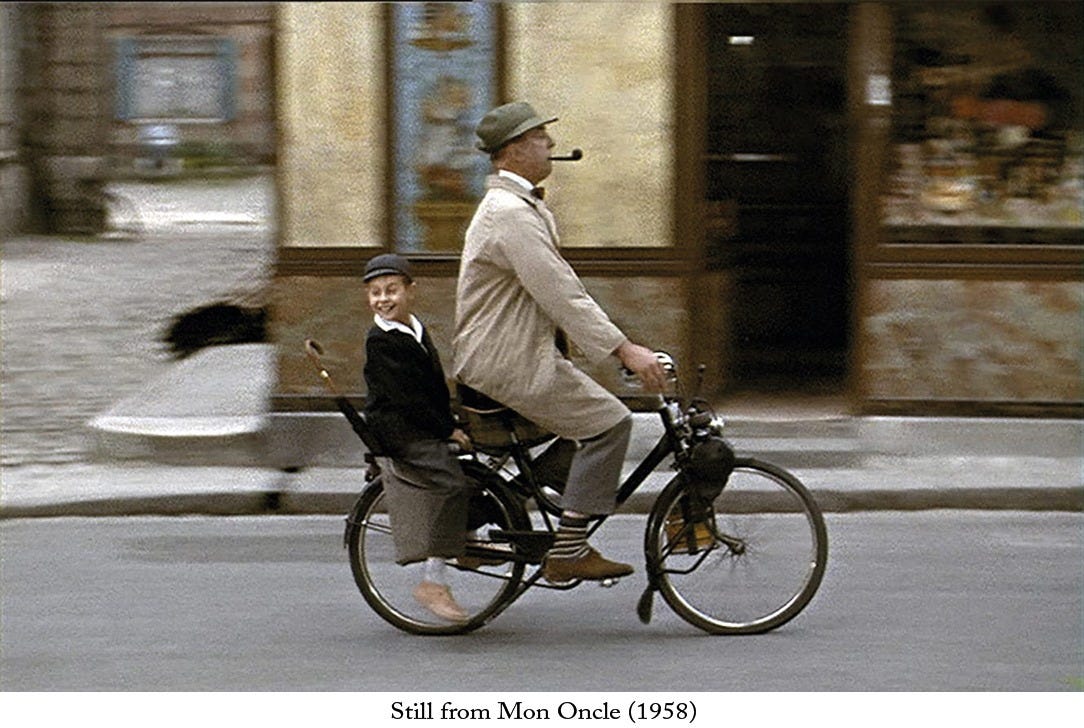
In Mon Oncle, Hulot finds it easier to get along with a child, his young nephew, than with the boy’s father, Monsieur Arpel. Arpel, who runs the hosepipe factory, is married to Hulot’s sister. They live in an absurd caricature of a modern house, described by Tati as a “pretentiously Modernist villa, so geometric as to have lost any human or inhabitable character”. The interior is minimalist, austere and uncomfortable. The exterior boasts a ludicrously winding path, needlessly doubling the distance from gate to front door, and a hideous fish-shaped fountain, which Madame Arpel turns on only for visitors she wants to impress.
Hulot lives in a quirky building in an older neighbourhood where the communal square is always full of life, in stark contrast to the antiseptic soullessness of the Arpel home. Madame Arpel, who is forever cleaning, becomes agitated when her son comes home grubby from playing with boys in the old quarter, and when the dog returns from running around there with other dogs. The Arpel parents do not play with their son, who is bored stiff at home. He much prefers to be with Hulot or playing with the boys in his uncle’s neighbourhood.
Before it became clear that Mon Oncle was a box office success, and later an Oscar winner, the film was criticised as reactionary. This was unfair; Tati was not against modernism per se, but against pretension and uniformity. Above all, he wanted people to have fun, to find humour in their lives and to play. As Turvey puts it, “to have fun within the modern world rather than to oppose modernisation”.
Hulot conveys this in a gentle way, as a catalyst rather than a protagonist. Just as his time at the hosepipe factory results in chaos, so the pristine perfection of the Arpel house unravels when his sister organises a garden party to set him up with the lady next door. Hulot accidentally punctures the pipe leading to the fish fountain, and a geyser erupts in the middle of the gathering. The guests try to move their chairs and tables away from the spray, but the absurd layout of the Arpels’ garden makes this impossible. A strange thing then happens: the party becomes more relaxed, and people start to have fun.
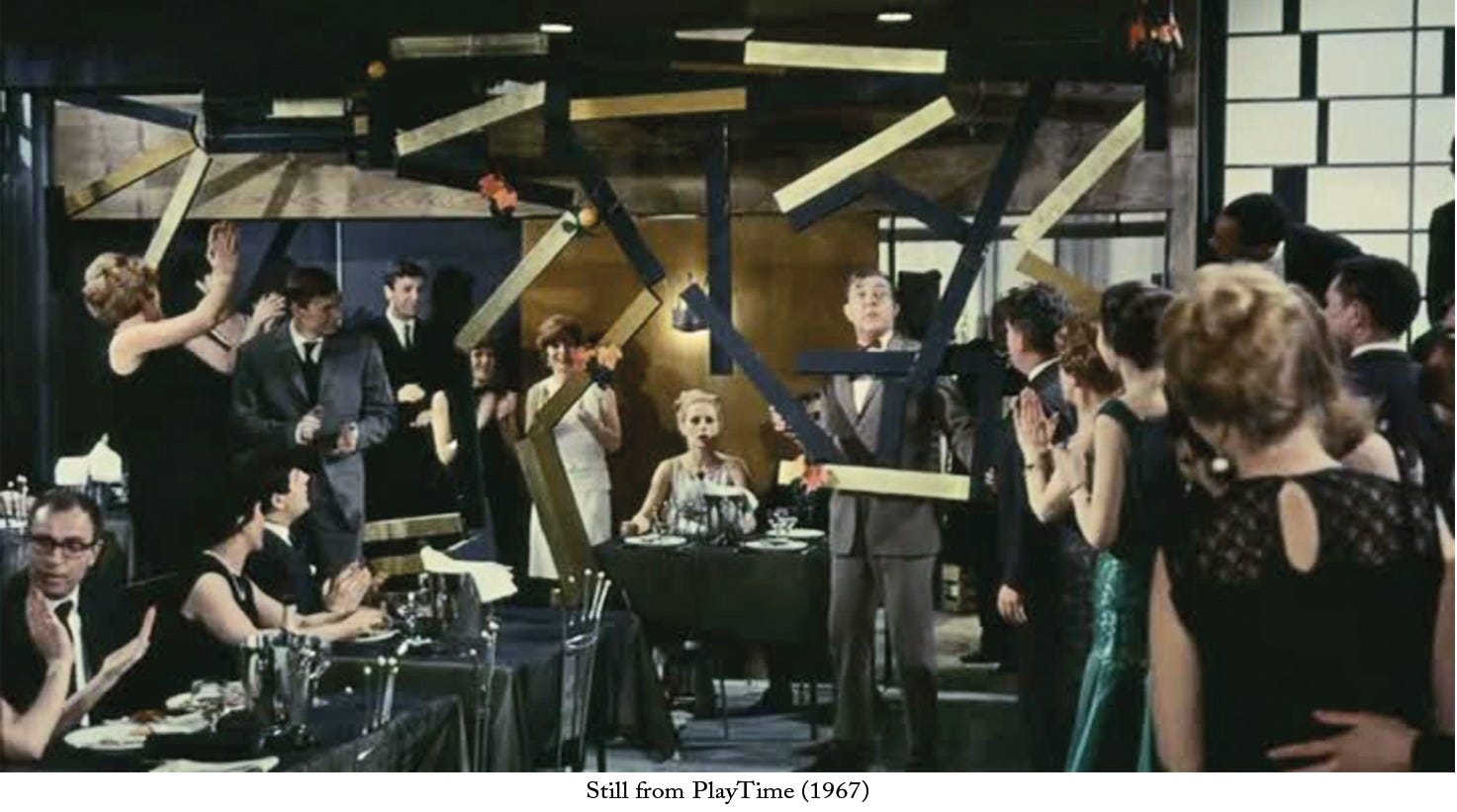
A similar thing occurs in Playtime when, trying to be helpful, Hulot accidentally causes the ceiling décor in a brand new pretentious restaurant to collapse. Almost immediately the ambience shifts from one of stiff formality to, in Turvey’s words, “uninhibited revelry”. Once the rigid geometry of the surroundings is disturbed, the diners feel free to play. Haughty Parisian diners and waiters now relax and dance with American tourists.
As the atmosphere becomes playful, the movie itself becomes colourful; up to that point, it is predominantly shot in shades of grey. As the movie ends, even a roundabout jammed with cars is portrayed as a kind of merry-go-round, and a passenger on a moped and vehicles on mechanical lifts at a nearby garage go up and down like carnival horses. Thus PlayTime, which begins with a sterile scene that looks at first like a hospital but turns out to be an airport, ends with colour, music and playfulness.
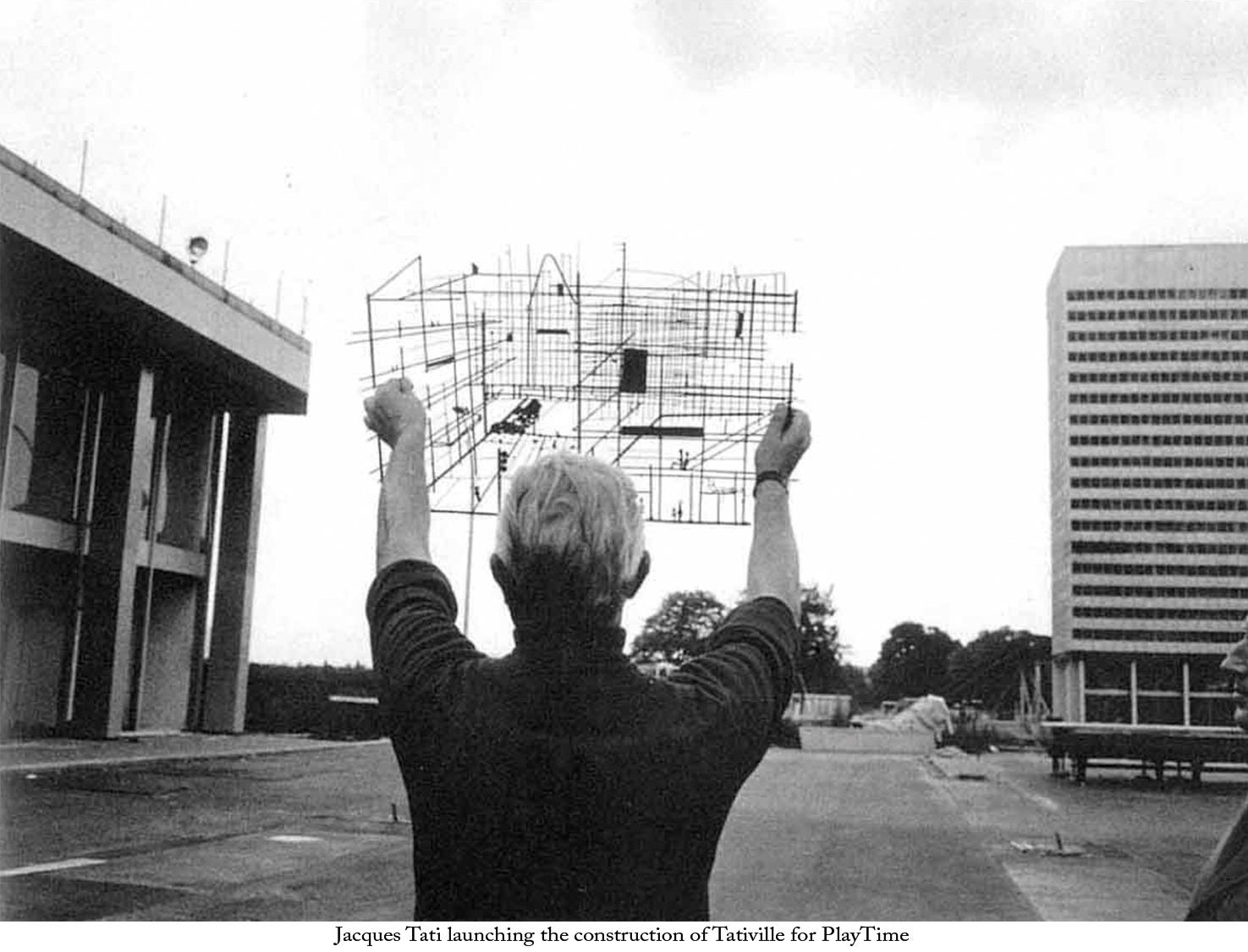
PlayTime is Tati’s masterpiece, much appreciated now but not when it was released. Sadly, it bankrupted him. He spent his entire fortune making it. He built an enormous set, including an airport terminal, various buildings and roads, and huge movable facades. Almost a mini city, it was dubbed ‘Tativille’. Tati hoped that it would be used by other filmmakers, but it was demolished to make way for road construction.
The movie took years to shoot, and Tati opted for the new and very expensive 70mm film rather than the usual 35mm. Described by film critic Roger Ebert as “that grand epic format that covers the largest screens available with the most detail imaginable”, 70mm had previously been used for such grand epics as Cleopatra (1963) (and that nearly bankrupted a studio).
Why did Tati insist on such a format when he was filming mainly the interiors of buildings rather than vast panoramas? PlayTime is a large canvas, often filled with activity in the foreground, the background and the ground in between. Breughel the Elder and Hieronymous Bosch produced paintings like that, but the viewer had plenty of time to stand and examine them. Not so with a moving picture! PlayTime is not the only Tati film that repays careful watching and rewatching.
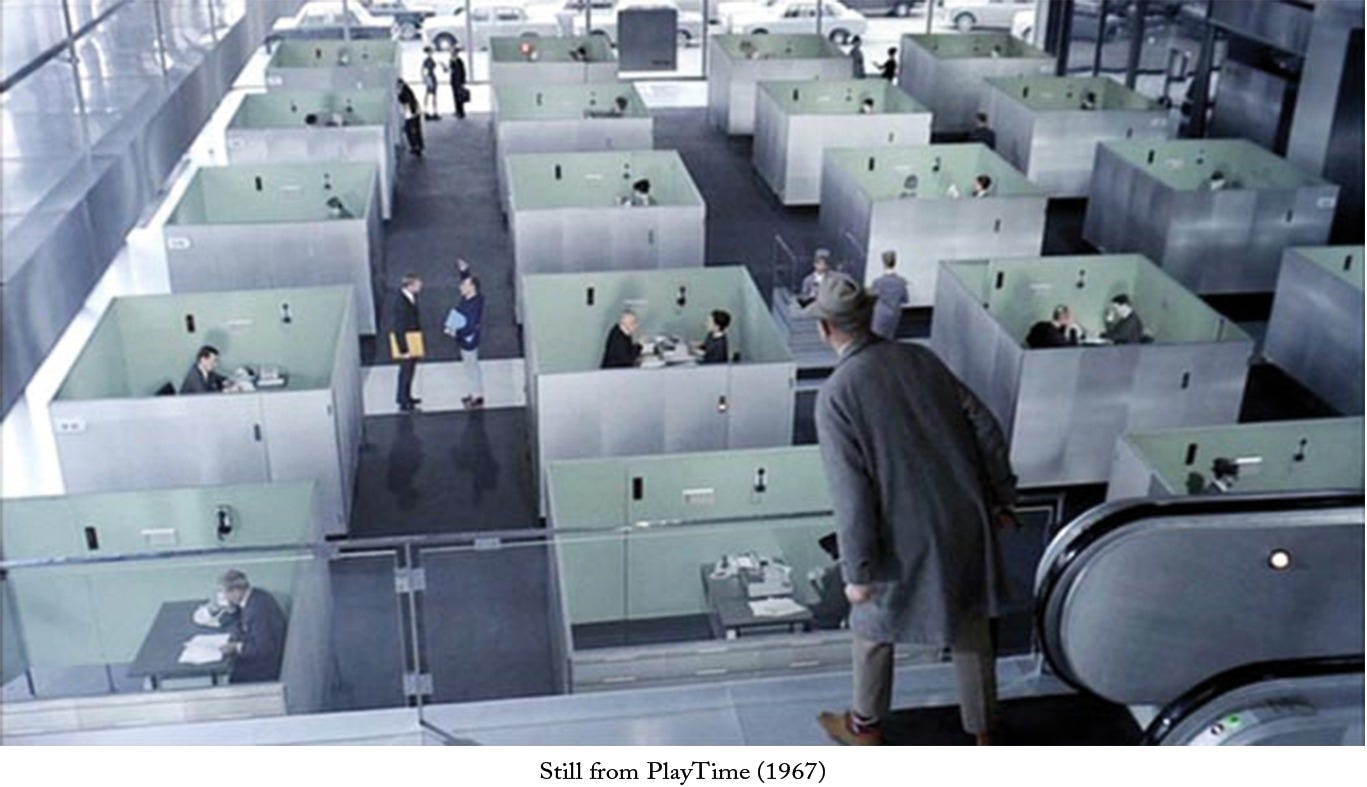
Much of the humour in Tati films is hidden, or half-hidden, and the absence of close-ups requires the viewer to observe closely all that is going on. The comedy is not always centred on Hulot, or any other character. Rarely do we see facial expressions, but there are visual gags everywhere. An elderly doorman in PlayTime struggles at length with an absurdly complicated intercom system that looks as if it belongs in the Apollo space programme. Office workers in neighbouring cubicles communicate with each other by telephone. Some visual gags are easily missed, such as travel posters in PlayTime advertising different world cities, but always with a picture of the same featureless modern skyscraper.
Dialogue is minimal, but sound is not. Tati often exaggerates and distorts sounds – a label fluttering loudly on the luggage of a diminutive VIP who is never identified, whoopee-like seat cushions, the blast of nasal spray and multiple other noises from someone nervously preparing to be called to an interview. Leonard Maltin called Tati “the only man in movie history to get a laugh out of the hum of a neon sign”.
Tati’s message is both serious and good-humoured: comedy is everywhere if you care to look for it. He both plays with his viewers and demands that they pay close attention. Not everyone gets it. They certainly did not get PlayTime in 1967. There has been no movie like it since, and it seems highly improbable that any will be made in the future. For that reason, if no other, it is worth watching today, with a combination of care, patience and, yes, playfulness.
thanks for this wonderful tribute that brings back all the memories of watching films I found truly enchanting.
The films are great in cinemas, if the audience does go along. For me, these are among the best memories I take from watching films. So I was very glad to see this article.