

Strategic Play
Game theory: Entering the Goldilocks zone - by Oliver Roeder

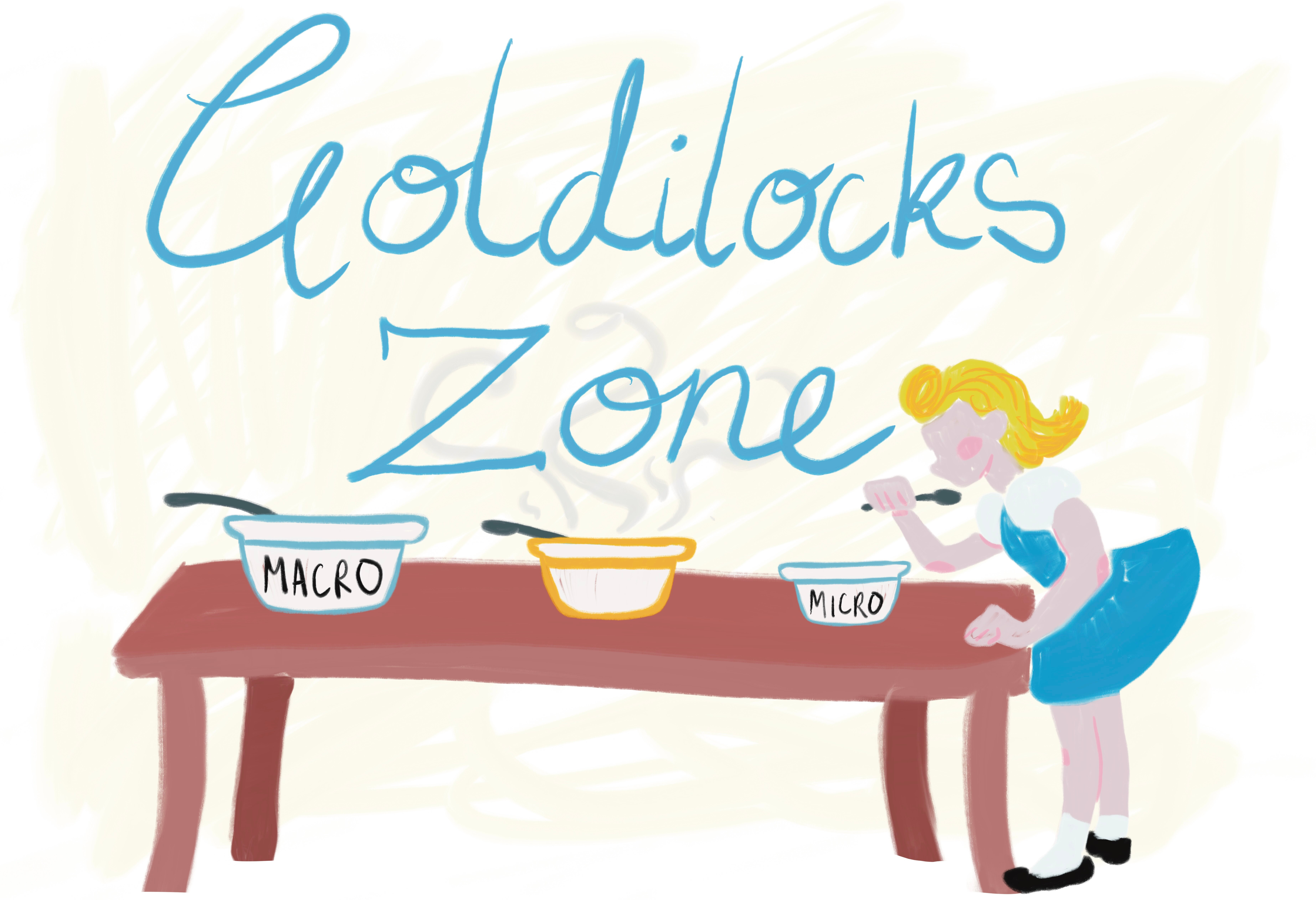
Economics can sound like dry stuff. It is the study of trade-offs and the allocation of scarce resources. The field can be cleanly divided into two disciplines. Macroeconomists are concerned with large entities and newspaper-headline data − nations and central banks, GDP and unemployment. Microeconomists, on the other hand, busy themselves with the choices of single actors − you or me, or an individual company down the street.
In macro, there are so many people that no individual’s decisions matter; we are all aggregated into a faceless composite called a ‘country’, for example, where we are atomic. In micro, on the other hand, only an individual’s decisions matter, and we are the whole world. This leaves an economic vacuum: in neither of these fields is there a proper accounting of the interactions between human and human.
Into this void − between the macro and micro, in the Goldilocks zone − rush game theorists. Game theory encompasses just enough actors (two or three or even a hundred) that what you do affects me, and what I do affects you − as if we were, say, playing a game. Game theory is, therefore, the formalised study of strategy, somewhere off in the corner of the economics department.
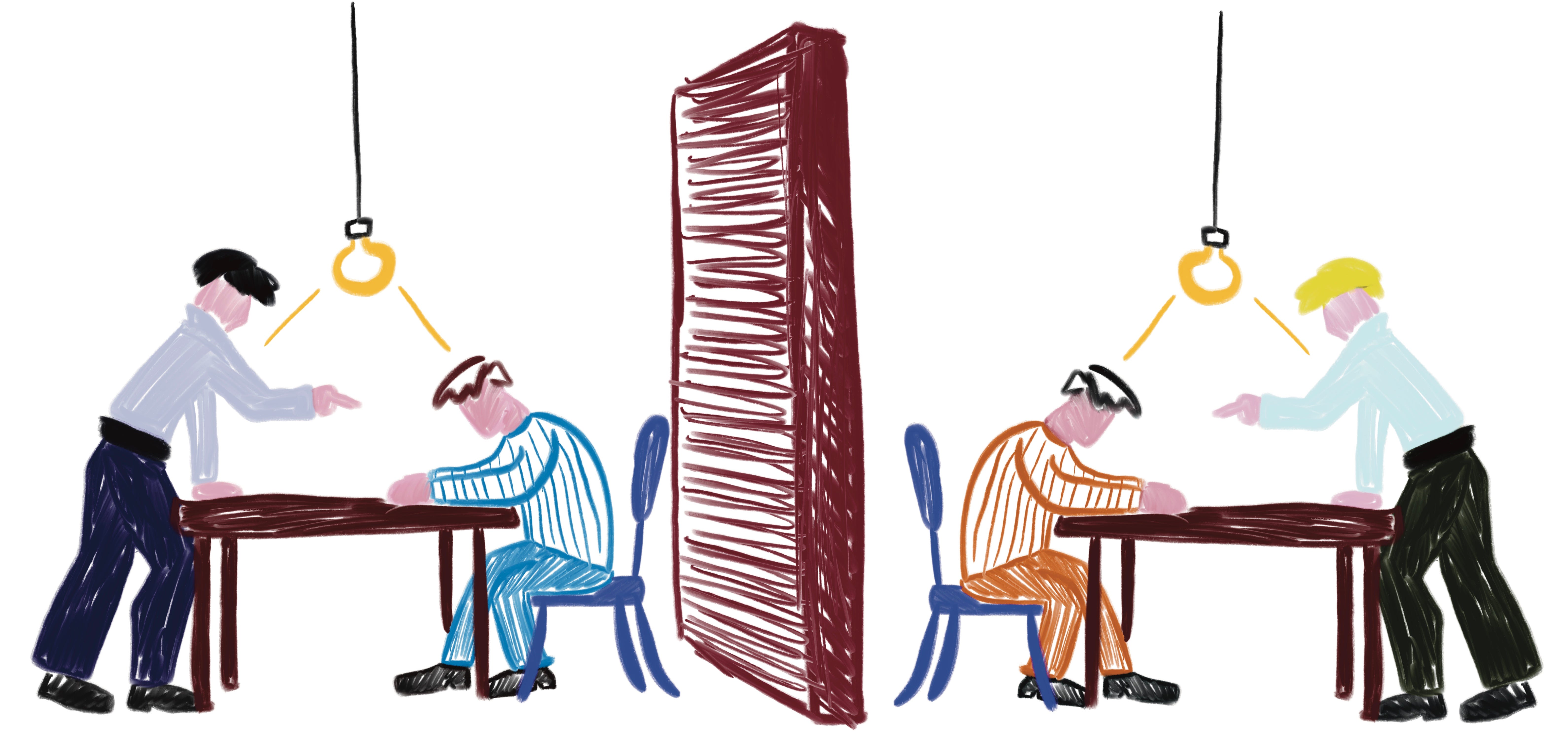
Let us proceed by example. The canonical game theory game is called ‘the prisoner’s dilemma’. Its story runs as follows. You and I have been arrested for a crime, and are being interrogated in separate, soundproof rooms. The interrogator gives us a choice: we can each remain silent or testify. If we both remain silent, the interrogator explains, we each get one year in prison. If we both testify, we each get two years in prison. And if one of us remains silent and the other testifies, the silent person gets three years and the testifier, rewarded for his lone cooperation, goes free.
What do we notice about this dilemma? Clearly, it’s best for our friendship if we both just shut up. We each get just one year, and we minimise the total number of years we spend locked up. But already, from this toy example, game theory delivers its first surprising result. Game theory says we’ll both testify − a horrible result for both of us, maximising the total amount of years we spend locked up.
Why? Let us assume you testify − then I am better off testifying. Let’s assume you remain silent − then I am still better of testifying. This is a standard game theoretic method: hold fixed the strategy of other players, and work out what’s best for you. The other players do the same. If there is an outcome, after that analysis, where no one wants to change their strategy, then we are in ‘Nash equilibrium’, the solution to the game.
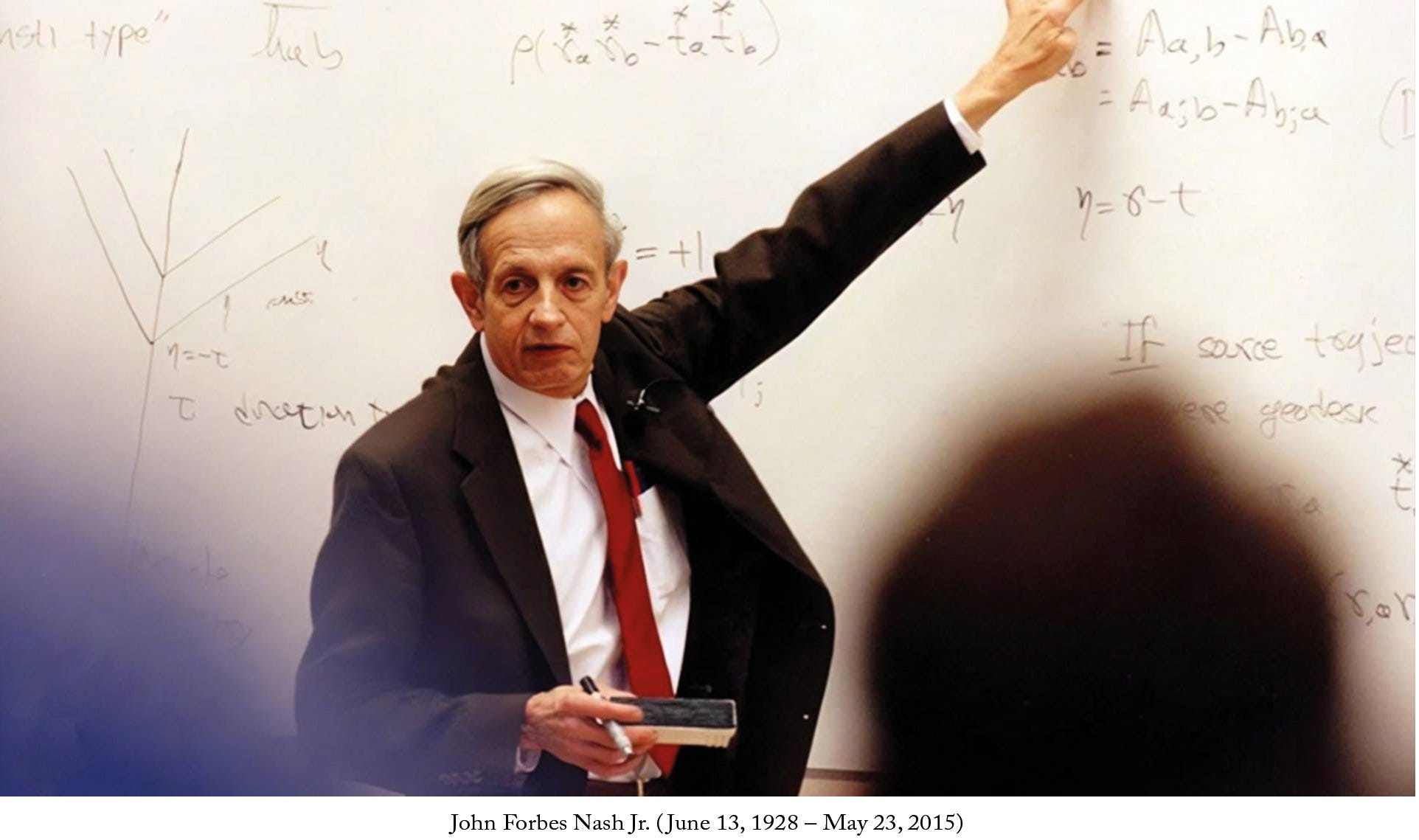
Nash equilibrium is the workhorse concept of game theory. It is named after John Nash, the 1994 Nobel prize winner in economics and subject of the film A Beautiful Mind. As Nash himself put it in a seminal 1951 paper: ‘Thus an equilibrium point is an n-tuple such that each player’s mixed strategy maximises his payoff if the strategies of the others are held fixed. Thus, each player’s strategy is optimal against those of the others.’ In more recent work, depending on the nature of the game, the concept is refined to things called subgame perfect equilibria, perfect Bayesian equilibria, trembling-hand equilibria, so-called folk theorems and so on. Professional game theorists spend their days using the tools to solve games. Nice work if you can get it.
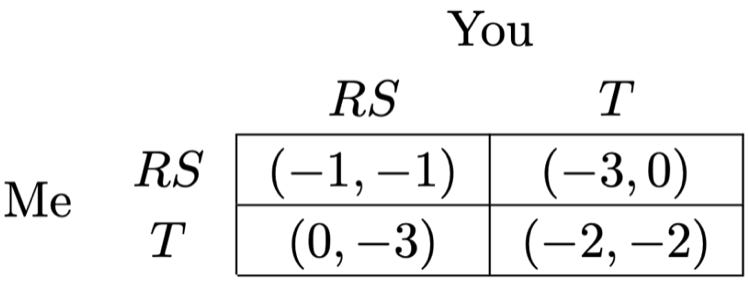
Game theorists usually write down a game in one of two ways. As a box, called the normal form:
Or as a tree, called the extensive form:
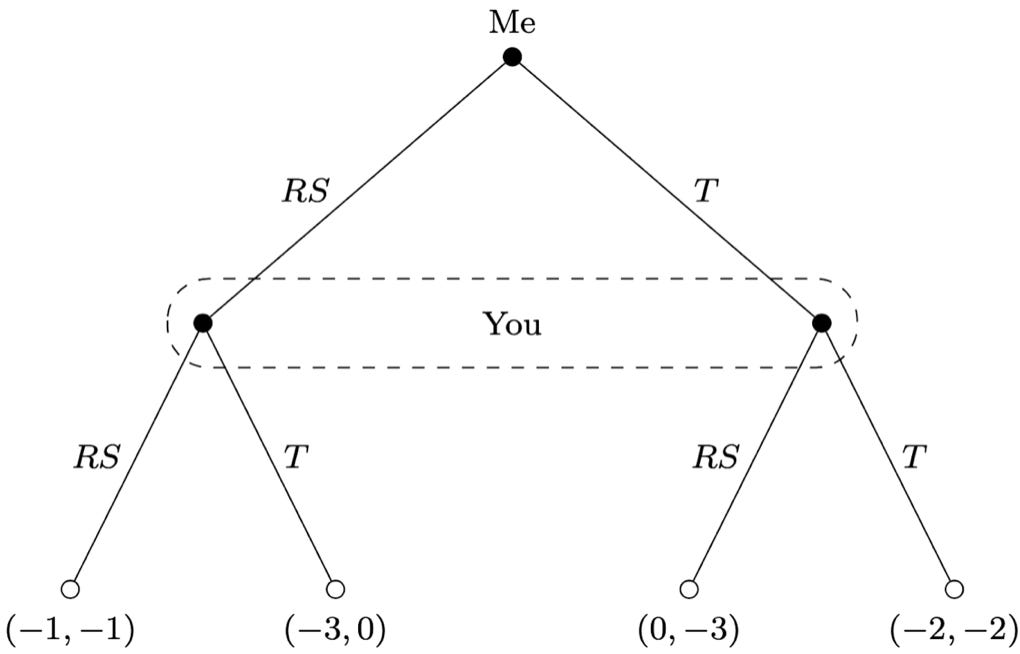
Each of the diagrams above is the prisoner’s dilemma described earlier, with our decisions of remaining silent (RS) or testifying (T). The numbers listed are our pay-offs: they are negative, in this case, because we do not like years in prison. Our goal is to arrive at the highest pay-off, taking into account the mirror incentives of the other player. The dashed line on the tree is called an ‘information set’; it’s there because you don’t know what I’m doing when you make your decision.
These are the stark aesthetics of game theory. A remarkable array of human interactions (games) can be written down and solved in these forms, subtle human dynamics captured in boxes and trees. A list of common textbook games gives a sense of the melange: hawk-dove, stag hunt, the beer-quiche game, battle of the sexes, matching pennies, bargaining games, the pirate game, screening games, signalling games. In grad school, my game theory professor once gave us a game about monkeys selecting bananas that were floating down a jungle river. It took an entire weekend to solve.
Professional game theorists stretch and warp and clone and combine and otherwise torture simple games like the prisoner’s dilemma, creating new games and modelling real-world situations, with fascinating and surprising solutions.
What happens, for example, if we play the prisoner’s dilemma not once but over and over and over again? In that case, just shutting up can be an equilibrium! If we’re playing again tomorrow, I can punish you if you testify against me today. If we’re not, you might as well screw me over today. The fact of a future encounter incentivises cooperation. It’s a natural human conclusion, tidily delivered by the maths.
Game theory applies to more traditional games, too. In poker, for example, the modern game has been taken over by GTO, or game-theory optimal, play. Driven by Nash equilibria and powerful software, this renewed analysis has transformed the card game from an exploitative game, where one takes advantage of opponents’ weaknesses, to a game of making yourself unexploitable. If you play this way, obedient to Nash, it doesn’t much matter what the other players are doing — you’ve already worked through their possible strategies in your analysis. This partially explains why top young poker pros now sit at the table beneath hoodies, sunglasses and oversize headphones.
And game theory, finally, applies to the real world (thank goodness) at both its most awesome and most arcane. The spectre of nuclear war, for example, has kept countless game theorists busy over the years, analysing the incentives of superpowers and hanging more than their hats on the sound mathematics of mutually assured destruction. And on the other hand, an entire and active subfield of game theory is devoted solely to auctions.
At its core, game theory, like calculus, is an enlightening way of thinking mathematically about the world − a clean and profound mental model. A friend of mine used to advise me, in order to avoid anxiety, ‘Don’t do the other guy’s thinking for him.’ For the game theorist, this is difficult advice to follow indeed. The student of game theory often ends up thinking, ‘If I do this, then you’ll do this, then I’ll do this, then you’ll …’
🐻
‘The prisoner’s dilemma’ - very interesting!