

Playbill

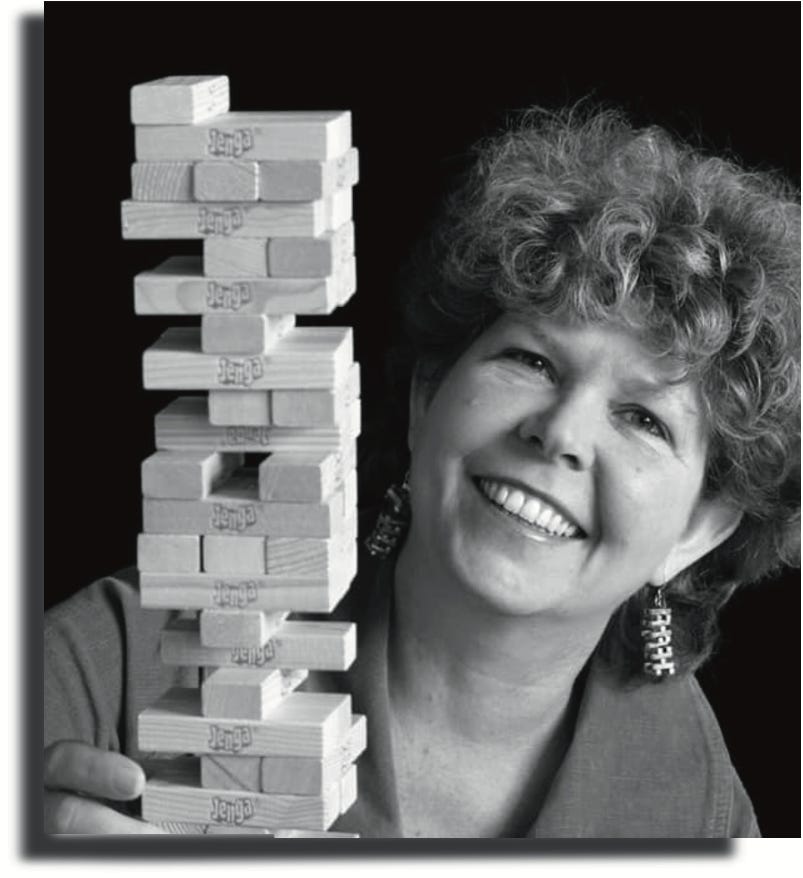
Leslie Scott
Leslie Scott, curator of Boundless Play, is a seasoned game designer best known for designing the global phenomenon, JENGA, although she has many other published game titles, too. These include word game classics such as; Ex Libris; Anagram; Bookworm, and Flummoxed.
Leslie is a founder director of Oxford Games Ltd, author of About Jenga; the remarkable business of creating a game that became a household name, and a TEDx speaker. She is the proud recipient of the toy industry’s TAGIE Lifetime Achievement Award, 2022, and is greatly honoured to be both a Senior Associate of the University of Oxford’s Pembroke College and the newest Fellow of the Ashmolean Museum, the oldest public museum in the world.

Frederica Scott Vollrath (aka Freddie)
Freddie Scott Vollrath provides all the design and technical support for the Boundless Play Substack, which includes illustrating much of its content. Working from her studio in Copenhagen, Freddie is a well-established board games designer with several published titles including Slappy Camper, and several more in the works. She also creates unique pieces of furniture with a monstrous twist.

Bob Peirce
Bob Peirce is a former diplomat, with postings in the British Embassies in China and Washington DC, and at the United Nations Security Council in New York. He was the secretary for external relations in the Hong Kong Government before the handover from Britain to China in 1997. As Consul General in Los Angeles, his last diplomatic post, he co-founded BritWeek, an annual festival celebrating creativity of all kinds.
Bob has also specialized in policing reform, drafting seminal reports for changes in Northern Ireland (1998) and the Republic of Ireland (2018), and advising on projects in East Asia, South America and the United States, where he is based. In 2022, he co-authored a book Seven Ways to Fix Policing NOW
He is more playful than this bio might suggest.

Harry Pearson
Harry Pearson is the author of twelve works of non-fiction. The Far Corner – A Mazy Dribble through North-East Football, was runner-up for the William Hill Prize and has been named as one of the 50 Greatest Sports Books of All Time by both The Observer and The Times. He wrote a weekly sports column in The Guardian from 1996 to 2012, and won the 2011 MCC/Cricket Society Prize for his book about Northern club cricket, Slipless in Settle. He won the MCC/Cricket Society Prize for a second time in 2017 with Connie, his biography of Learie Constantine. His latest book No Pie, No Priest was long-listed for the William Hill Prize and covers Britain’s less celebrated sports from cheese-rolling to quoits via shinty and aunt sally.

Jerome Fletcher
Jerome Fletcher is a retired Associate Professor of Performance Writing, now living in central France. He was a three-time British Professional Real Tennis doubles champion (after a short career as an eel catcher) and took part in the first ever public Jenga competition.
He has written three children’s books, among them Escape from the Temple of Laughter which included games designed by Leslie Scott. The children’s books led to a short career in Theatre-in-education working with the Big Wheel company. He has co-written four books on aspects of decadence, including The Decadent Sportsman. This quartet provided the basis for an ongoing series of performances and readings at such venues as the Kunsthalle Vienna, the Barbican London and the Leo Koenig Gallery in New York.
He has translated French novels into English. The latest, George Magnane’s Où l’herbe ne pousse plus, is published by Dedalus Books. As an academic, his area of research was in electronic literature and was largely practice-based. He produced a series of interactive digital literature works and performances - including a commission from the University of Dundee - as well as writing a number of academic articles on theoretical aspects of this literary form. Jerome is now writing a fourth children’s book, directing a play, playing with his dog, Jambo, and rowing his Venetian boat around the second largest man-made lake in France.

Tom Whipple
Tom Whipple is Science Writer and Special Correspondent at The Times. He has worked for the paper since 2006, and specialized in science since 2012. He writes reviews, features and news across the paper, has a weekly science column, and regularly appears and presents on Times Radio. Tom joined The Times shortly after graduating with a degree in mathematics. During the course of his career he has visited the tunnels below Cern and the top of Mont Blanc above it. He has been in the world’s hottest sauna and the world’s most irradiated nature reserve. He has interviewed Stephen Hawking and Jedward. He was named Science Journalist of the Year for his coverage of the COVID pandemic.

Keri Blakinger
Keri Blakinger is a Los Angeles-based investigative reporter and 2024 Pulitzer Prize finalist who has been reporting on prisons and the legal system for over a decade. She’s been a staffer writer at the Houston Chronicle, The Marshall Project and the Los Angeles Times. She is currently on the national team at ProPublica, a nonprofit news outlet that investigates abuses of power.
Her work has appeared in outlets from the BBC to VICE, and from the NY Daily News to The Washington Post Magazine, where her reporting on women in jail helped earn the publication a 2020 National Magazine Award for best single-topic issue. The following year, her coverage of the effects of the pandemic in U.S. jails was named a National Magazine Award finalist. She is also the producer of “I Am Ready, Warden,” a short documentary that was nominated for a 2025 Academy Award. She is a former New America Fellow and the author of “Corrections in Ink,” a critically acclaimed 2022 memoir about her time in prison and her path to criminal justice reporting.

Tim Walsh
Tim Walsh is a toy and game designer, author, and speaker. His first book, Timeless Toys (Andrews-McMeel), was praised by The Wall Street Journal and USA Today. His second, WHAM-O Super-Book (Chronicle Books) was picked by NPR as “One of the best gift books of the year.” As a speaker, Tim is out to prove that play is not a four-letter word, but a means through which we can super-charge creativity and connect with others.

Stephen Kidd
Stephen Kidd is a professor of Classics at Brown University. He is the author of Play and Aesthetics in Ancient Greece, published in 2019, which explores the ancient Greek concept of play (paidia) and its relationship to literature, theatre, visual arts, and music. He has also written the books Nonsense and Meaning in Ancient Greek Comedy (in 2014) and Lucian on Reading, Performing, and the Difference (in 2025). Some of his articles include topics such as ancient board games, gambling, and the origin of mathematical probability -- which began, like so much else, as a game.

Matthew Kaiser
Matthew Kaiser is Professor of English at University of California, Merced. He is drawn to the electric spaces between different planes of reality, where the world as we know it coalesces and collapses. Everything that he writes is informed by his experience living with language-induced epilepsy. His seizures are triggered by metaphorical language, by the tangled realities that he encounters in literary texts. His intellectual interests, therefore, include play, literature, metaphor, laughter, and, of course, seizures.
He is currently writing a book, Seizures of Literature, about his experience living with this rare and very trippy neurological condition. Most of his scholarly publications focus on nineteenth-century British literature. These include The World in Play: Portraits of a Victorian Concept and A Cultural History of Comedy in the Age of Empire. He has also edited several volumes of nineteenth-century literature, including An Apology for Idlers and Other Essays by Robert Louis Stevenson; the two-volume Crime and Horror in Victorian Literature and Culture, which is based on a popular course that he taught at Harvard; and Venus in Furs by Leopold von Sacher-Masoch. With a colleague in Australia, Will Visconti, he is working on a four-volume anthology Comedy, Humour and Laughter: A Documentary History, 1800–1920. It covers everything from the science of laughter to the art of clowning. He lives in a high-rise in downtown Oakland, California and makes a point of watching the sun set over Mount Tamalpais, or San Francisco every day at dusk.

Angeline S. Lillard
Angeline S. Lillard is the Commonwealth Professor of Psychology at the University of Virginia where she directs the Early Development Laboratory and the Montessori Science Program; her research focuses on children’s play and Montessori education. She is an elected Fellow of the American Association for the Advancement of Science, the American Psychological Association, and the Association for Psychological Science, and Chief Editor of Frontiers in Developmental Psychology. She received her PhD in Psychology from Stanford University in 1991, and the American Psychological Association’s Boyd McCandless Award for her early career contributions to Developmental Science. Her book, Montessori: The Science Behind the Genius (Oxford University Press) received the Cognitive Development Society Book Award, is translated into several languages, and is currently in its 3rd edition. She has been keynote speaker at dozens of Psychology and Montessori conferences worldwide. Her research has been funded by the Institutes of Education Sciences, the National Science Foundation, the National Institutes of Health, and many private foundations.

Callan Davies
Callan Davies is a writer and researcher specialising in the culture and entertainment of the sixteenth- and seventeenth-centuries. He is Lecturer in Seventeenth-Century Literature and Culture at the University of Southampton. His latest book, What is a Playhouse? England at Play, 1520-1620, featured as one of History Today’s Books of the Year 2023, and his first monograph, Strangeness in Jacobean Drama, was shortlisted for the Shakespeare’s Globe Book Award 2023. He has written widely on early modern literary, cultural, and theatre history. Other recent publications include the new introduction for the Oxford World’s Classics The Merry Wives of Windsor and articles on bowling alleys, bears, and a co-edited collection on early modern ephemera. He is currently writing a popular history book contracted with Yale University Press provisionally titled Curtain: The Story of a Shakespearean Playhouse.

Jaakko Stenros
Jaakko Stenros (PhD) is a University Lecturer in Game Studies working at the Game Research Lab, Tampere University. He has published eleven books and over a hundred articles, and has taught game studies for well over a decade. Stenros studies play and games, his research interests include norm-defying play, game rules, folk competitions, queer play, role-playing games, pervasive games, game jams, and playfulness. His work can be divided into four categories: work on foundational concepts of game studies (e.g. The Rule Book: The Building Blocks of Games, 2024), documenting and understanding game cultures (e.g. Nordic Larp, 2010; Pervasive Games: Theory and Design, 2009), ludic applications (e.g. Larp Design: Creating Role-Play Experiences, 2019), and reflexive work on game studies as a field (e.g. Minun pelihistoriani, 2018). Stenros has also collaborated with artists and designers to create ludic experiences and has curated many exhibitions at the Finnish Museum of Games. University of Turku has awarded Stenros the Title of Docent in 2019 in Game and Play Studies. In 2022 the Higher Education Video Game Alliance named him a HEVGA Fellow and in 2025 he was recognised as a Digra Distinguished Scholar.
Leland Masek
Leland Masek is a Doctoral Candidate at Tampere University’s program in Media, Communications and Performing Arts. His dissertation is on definitions of playfulness and wellbeing across discipline and culture. He directs the Games As Art Center in Tampere Finland, which not only hosts hundreds of public events a year on aesthetic and important play in games, but also is an active researching institution developing a scientific arts research method with games termed Ludic Inquiry. In addition, Leland Masek runs the Oasis Research Group at Tampere University, which studies the empirical well-being effects of playful behavior in games. He is a professional game designer with 14 years-experience and over 40 professional projects, predominantly in games for education, pervasive games, interactive theatre, and experimental game design.

Graham C. Scott
L.R.C.P. & S.I., M.B. B.Ch., B.A.O (National University of Ireland).
Graham Scott was born in London (while his parents were on Home Leave), and raised in East Africa. He attended a preparatory boarding school in Northern Kenya, subsequently moving to a secondary boarding school in England before reading Physics with Electronics at Sussex University. After a brief stint of painting white-lines on airfield runways, he studied medicine at the Royal College of Surgeons in Ireland. During this period his family moved from East to West Africa; thus, Accra, Ghana became home for a spell.
On graduation he completed an Internship in Trinidad and Tobago, followed by a Residency in North Carolina and a Fellowship in Pulmonary and Sleep Medicine, at the University of Kentucky. Scott was an assistant professor at the University of Missouri until 1991 when he moved to private practice in Charleston, South Carolina. He retired in 2021 after 30 years in practice.
During his youth, Scott played all the usual field sports: cricket, rugby, soccer, cross-country running, squash and horse riding. He was on the school swimming team and learnt how to scuba dive. Later, afraid that too much work and not enough play would make him a dull man, he started sculling in Charleston Harbour and took up playing the Great Highland Bagpipes. An avid philatelist since early childhood he continues to work (play?) on his Ethiopian stamp collection.
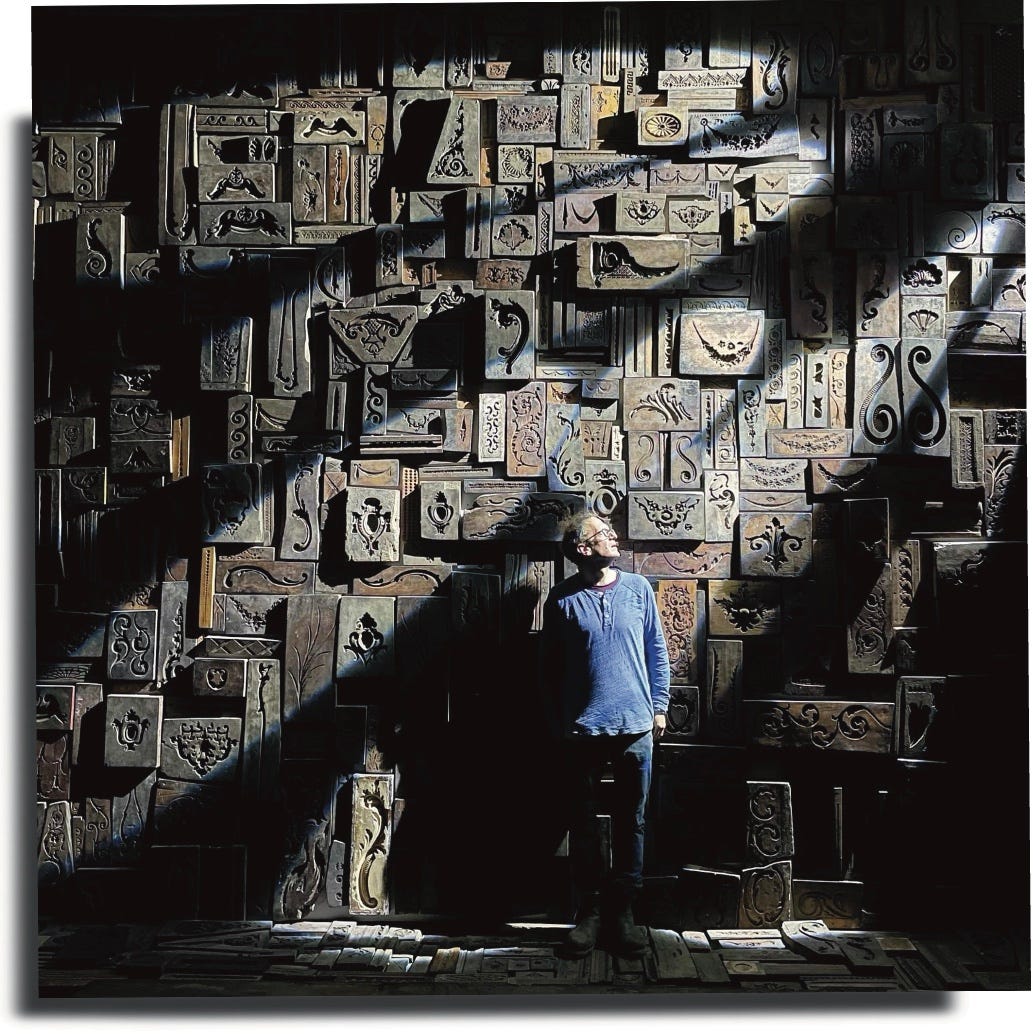
Anthony Reeve
Anthony Reeve is a shopkeeper and antiques dealer. He has been buying and selling Architectural Salvage for LASSCO for thirty years. He is often found rummaging in the fusty corridors of institutions, collapsing barns and the cellars of crumbling manor houses. He lives clumsily in an idyllic Oxfordshire village where wife and children have banned him from bringing anything else home. LASSCO Three Pigeons is the name of the shop – a true Aladdin’s Cave near Oxford UK - crammed with both spectacular antiques and useful and decorative doodads carefully removed from buildings both celebrated and forgotten: everything from marble fireplaces, wrought iron gates, stained glass windows, garden statues and entire panelled rooms.

Dan Rubenstein
Dan Rubenstein is a behavioral ecologist who studies how environmental variation and individual differences shape social behavior, social structure, sex roles and the dynamics of populations. He has special interests in all species of wild horses, zebras, and asses, and has done field work on them throughout the world identifying rules governing decision-making, the emergence of complex behavioral patterns and how these understandings influence their management and conservation. By working with computer scientists, he is advancing Computational Field Ecology to expand the scale and scope of conservation biology
Rubenstein is the Class of 1877 Professor of Zoology, Emeritus at Princeton University. He is former Chair of Princeton University’s Department of Ecology and Evolutionary Biology and has served as Director of Princeton’s Programs in African Studies and in Environmental Studies. He received his bachelor’s degree from the University of Michigan in 1972 and his Ph.D. from Duke University in 1977 before receiving NSF-NATO and King’s College Junior Research Fellowships for post-doctoral studies at Cambridge University. As the Eastman Professor, he spent a year in Oxford as a Fellow of Balliol College. He is a member of the American Academy of Arts and Sciences as well as Fellow of the Animal Behavior Society and the American Association for the Advancement of Science. He has received Princeton University’s President’s Award for Distinguished Teaching and he has recently completed terms as president of the Animal Behavior Society, the councils of AAAS and the Ecological Society as well as on the board of Sigma Xi, the Scientific Honor Research Society. He has also recently received the Animal Behavior Society’s Exemplar award and the Sigma Xi Honor Society’s McGovern Science & Society Award. He currently serves as Sigma Xi’s president as well as council member of Pennington Borough, NJ.

Martin Wainwright
Martin Wainwright worked for the Guardian for nearly 40 years and broadcast regularly on radio and TV. He has written books on a range of subjects from the Morris Minor to the North of England and the history of April Fools’ Day.

Sue Macpherson
Sue Macpherson, ARPS, is a UK photographer who grew up in Africa and from an early age enjoyed travelling to remote areas with her camera. Her passion for photography, expressed through portraiture and social documentary, led to regular visits to Uganda with The Henry van Straubenzee Memorial Fund, where Sue recorded the charity’s annual achievements and projects in numerous rural schools.
Sue was awarded Associateship of the Royal Photographic Society (RPS) for her documentary on Abbotsbury Swannery in Dorset. Over twenty years, whilst teaching Photography at Bryanston School, she has worked on a number of personal projects such as the life of a small racing stables and the workings of an alpaca farm, which have defined her love of visual narrative and storytelling. On completing a Photography MA, Sue was awarded the Bournemouth Arts University’s Photography prize for her major project ‘Look’. This was a documentary on visual impairment and loss of sight. Working in collaboration with the Dorset Blind Association she met and photographed local people with varying degrees of sight loss and recorded their inspirational stories. Her current work is with the RPS Women in Photography group who are producing a nationwide photographic celebration of women’s powerful and historic presence in Westminster. The 40% Project will result in a public exhibition of portraits of the 264 women MPs who now sit in the House of Commons. These will be displayed in locations across the UK in 2026.

Eric Zimmerman
Eric Zimmerman is a veteran game designer who makes award-winning games on and off the computer. Along with Peter Lee, he was the co-founder of Gamelab, a New York City-based studio that created original games like Diner Dash and worked with companies like Lego to create dozens of online titles. Other digital games include SiSSYFiGHT (with word.com), an online game about little girls in social conflict on a playground, Leela (with Curious Pictures), an X-Box Kinect launch title about play and meditation, and Dear Reader (with Local No.12), an Apple Arcade launch title that uses public domain literature as the basis of word puzzles. He was a co-founder of the Institute of Play, which designed entire schools where the curriculum was based on play and games as the model for learning. Tabletop titles include Quantum (with FunForge) and The Metagame (with Local No.12). With architect Nathalie Pozzi, he has designed installations that have been shown in the Museum of Modern Art, the Smithsonian American Art Museum, and other festivals and museums around the world. He is the co-founder of the top-ranked NYU Game Center, where he teaches as an Arts Professor. Eric’s books include Rules of Play (co-authored with Katie Salen) a textbook that helped establish game design as a discipline, and The Rules We Break, a compendium of his game design exercises. He teaches and lectures extensively about game design and is always ready to play.
Jonathan Kingdon
Jonathan Kingdon is a world-renowned artist and a leading scientist. Born in Dodoma, Tanzania, he lived and worked in East Africa for many years. He trained as an artist at the Ruskin School of Art in Oxford, and at the Royal College before teaching fine art at the Makerere University in Uganda. Kingdon currently lives in Rome and Oxford, where he has long been a Research Associate at the University of Oxford.
Since the 1980s, Kingdon has published and illustrated a major series of papers, and books, exploring the evolution of African mammals, culminating in the six-volume collection, Mammals of Africa - celebrated as a ‘Leonardo-like exploration of science with an artist’s eye’.
Jonathan’s latest work, Origin Africa, Safaris in Deep Time takes a new look at how Africa’s geological history, climate, geography and biology resulted in the wonderful diversity of life found there. It is also the story of how it was the crucible for the evolution of Homo sapiens. Origin Africa is an intensely personal portrait of a continent that is not only Kingdon’s personal motherland but also the birthplace of all humanity.
Megan Christo
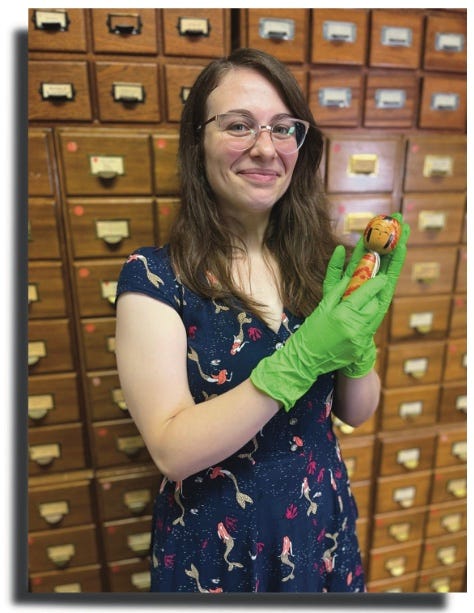
Megan Christo has spent 8 years working in the museums & heritage sector with a focus on collaborative research projects with source communities, and seeking opportunities for community engagement through museum objects. Her first community co-produced exhibition The A-Z of East London’s Women Inventors was displayed at Wanstead Library in March 2019, which sparked her passion for oral histories and uncovering the personal stories behind every-day objects. While working at the Pitt Rivers Museum on the Play! Project, Megan led two community research projects into traditional shadow puppetry and musical instruments with the local Chinese community. She also worked closely with members of the Hopi community, indigenous to Arizona, to explore the katsina dolls in the museum’s collection with the aim to challenge preconceived notions about dolls and play. Her favourite object she researched for Boundless Play is the daruma doll, due to its kinetic symbolism representing resilience and playful optimism in the face of adversity.